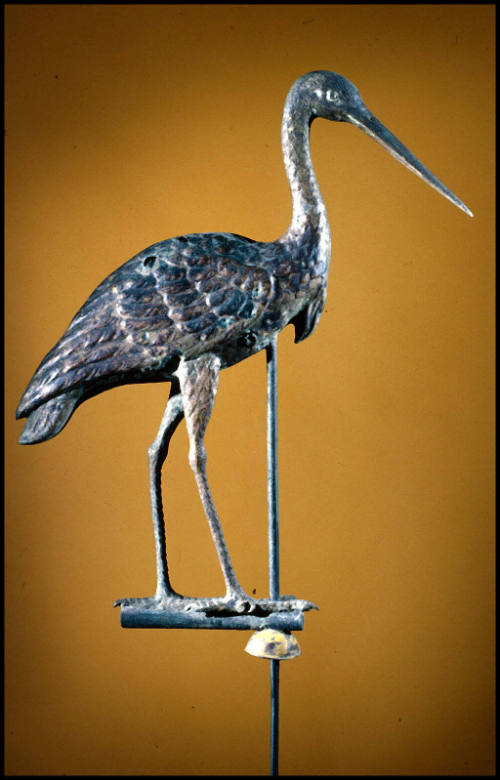
Weathervane: Stork
Date1875-1900
Possibly by
Harris & Co.
1867-ca. 1882
Possibly by
W. A. Snow Iron Works
active ca. 1885-1940
MediumCopper, zinc alloy, lead, paint, and gilding
DimensionsOverall: 28 1/4 x 22 1/2 x 4in. (71.8 x 57.2 x 10.2cm)
Credit LineMuseum Purchase
Object number1967.800.2
DescriptionA full-bodied molded copper weather vane in the form of a standing stork, its head and part of its neck being zinc alloy. He is shown striding, his proper R foot placed ahead of his L. He stands on the vane's horizontal bar, its vertical pole running in front of him up to his chest. He has three toes on each foot. Directly below the horizontal bar (and below the bird's proper R foot) is the top half of a metal ball. [The lower half of the ball shows in a 1968 CW photo so apparently was lost post-acquisition].Label TextIn Europe, rooftop platforms were sometimes built on houses in the hope that storks will use them as nesting places, for legend holds that these birds bring good fortune as well as babies. Stork weather vanes were made and sold in America, but the birds are not native to this country and the rarity of American stork vanes suggests that they were never very popular here.Harris & Company of Boston advertised a stork vane in its 1879 catalog, but by 1885, the firm's molds had been acquired by W. A. Snow & Company (later, The W. A. Snow Iron Works), making a specific attribution for this unmarked example difficult.ProvenanceSpencer & Judd, Inc., New York, NY.
1875-1900
1860-1880
1860-1880