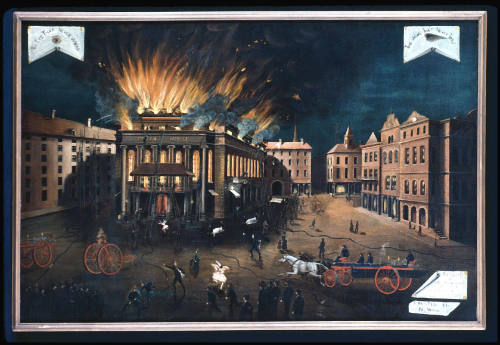
The Burning of the Opera House
Date1887-1896
Artist
Nicholaus Wirig (1860-1896)
MediumOil on canvas
Dimensions(121.3 cm x 182.6 cm) Framed: 49 1/2" x 73 5/16"(125.7 cm. x 186.2 cm.) Unframed: 47 3/4" x 71 7/8"
Credit LineMuseum Purchase
Object number1966.101.1
DescriptionOil painting probably originally a parade banner of fire in cityscape. In center of canvas is an opera house with fire in oranges and yellows blazing on second floor and out the roof of a two story opera house with six Ionic columns on the front. The fire casts shadows around the base of the building while lighting up the facade of the surrounding buildings in the night. The opera house is built slightly to the left of center of a group of three and more storied buildings. Flames leap upward from its roof and firemen climb up several ladders to hose it down from nearby buildings. Figures mill around silhouetted against the blaze, on second floor of porch of building. Reflection of blaze visible in windows. Two girls in pink winged costumes flee from the building. One sees a clock face set to 8 o'clock on top of building to the right. Groups of firemen hold white sheets for people to jump into and various fire wagons are visible, including a two-wheeled hose wagon, the back half of a hook and ladder truck, and grey and black horses pulling a ladder truck in from the right side. Pieces of paper with suitable inscriptions are painted into the corners of the scene in tromp l'oeil fashion and various firemen are visible. The foremen holding a large horn in the center gestures toward the fire. This figure is reminescent of Currier and Ives figures, and people watch the scene. There are strong areas of light and dark, creating feelings of drama and quiet about the scene.Label TextAlthough the source of the scene depicted has not yet been determined, Nicholaus Wirig created a spectacle that reflects the perils and drama of firefighting. The blazing opera house, the casualties being removed on stretchers, and the frantic activity of the firemen remind us how fearsome a threat fire was in the nineteenth century and what a toll it took on American cities.Inscription(s)In lettered black paint in the banner at upper left is "THE EYE THAT NEVER WINKS"; in the right upper banner, "THE WING THAT NEVER TIRES"; in the trompe l'oeil paper at lower right is "PAINTED BY/N. Wirig."; above this is "PRESENTED/BY/B. BRAHM & N. WIRIG./ THE WIDE AWAKE/H. H. & L. Co. No. 2/ Dec. 31 1887."ProvenanceDavid David, Inc., Philadelphia, PA
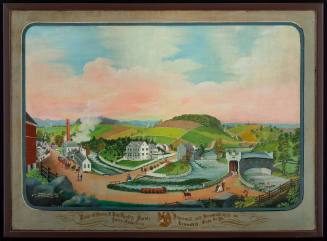
Charles C. Hofmann (ca. 1820-1882)
1872
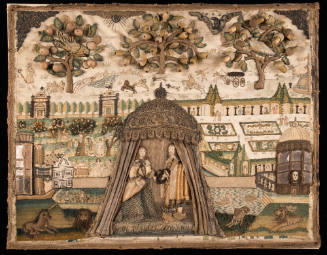
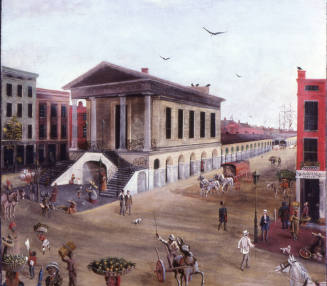
1852-1865 (probably)
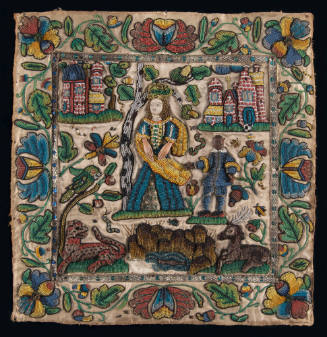
1650-1675