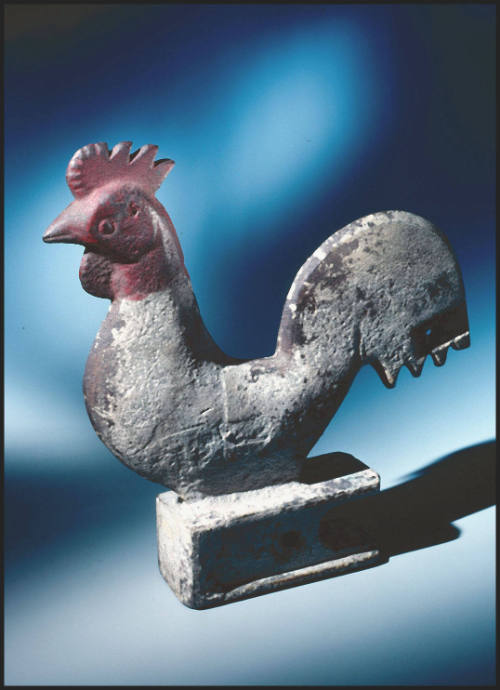
Windmill Counterbalance Weight: Rooster
DateProbably 1887-1915
Attributed to
Elgin Wind Power and Pump Company
(active 1887-late 1940s)
OriginAmerica, Illinois, Elgin
MediumPainted cast iron
DimensionsOverall: 19 x 18 1/2 x 3 1/2in. (48.3 x 47 x 8.9cm)
Credit LineMuseum Purchase
Object number1957.808.1
DescriptionA solid, sand-cast, iron figure of a rooster, the tail relatively flat but the body rounder, set upon a rectangular block, the bird's head painted red, the body white.Label TextThis sand-cast rooster served as the counterbalance weight on a sectional, vaneless windmill. Perched on the end of the arm, it met the wind head-on, leaving the wheel itself to turn behind it. It also counterbalanced the weight of the wheel, thereby equalizing stress on the turntable casting.Manufacturers of sectional vaneless mills readily perceived that their cast iron counterbalance weights could double as trade signs. Thus, certain motifs were adopted by and, in some cases, exclusively associated with particular makers. The Elgin Wind Power and Pump Company chose roosters and squirrels as its emblems, but only the former were produced long-term (note 3). Elgin cast at least eight different primary rooster forms, as well as secondary size and weight variations of these main designs (note 4).
ProvenanceOwnership prior to Halpert (see Source) is unknown.
1866
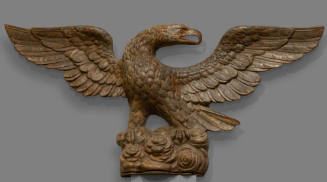
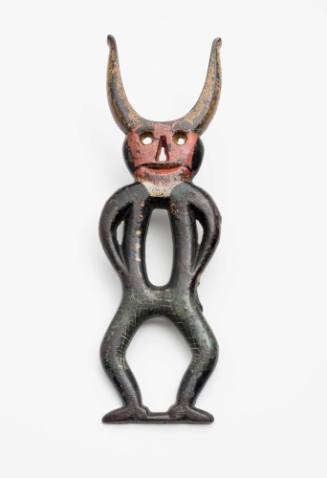
Possibly 1850-1875
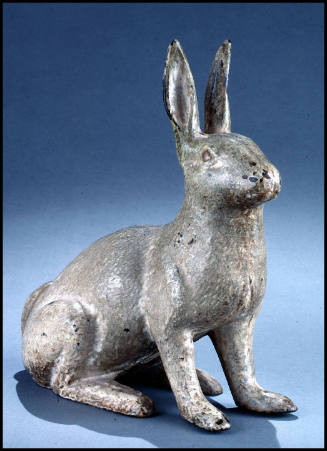
J. L. Mott Iron Works
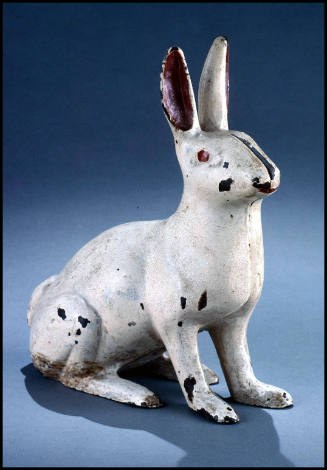
J. L. Mott Iron Works
1820-1850
1760-1800 (possibly)
1825-1850
1760-1800 (possibly)