
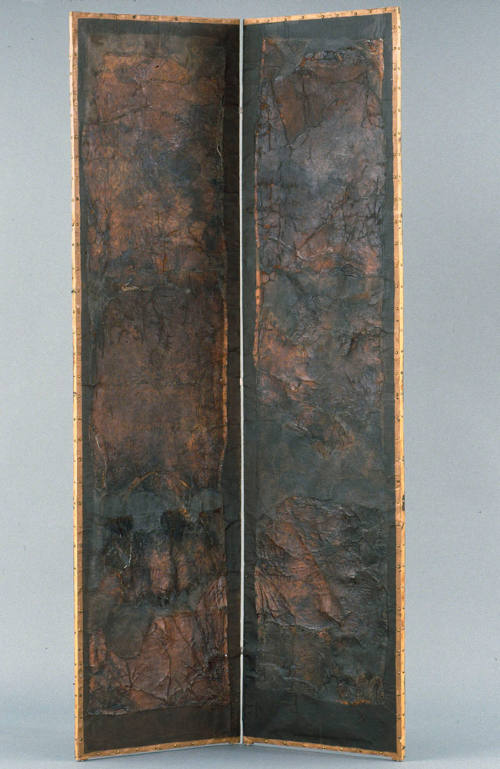
Folding screen
Date1710-1745
OriginGreat Britain
MediumRed pine (by microanalysis), leather, iron, and brass.
DimensionsOH. 96; OW. 48; OD. 7/8.
Credit LineGift of William Bradshaw Beverley.
Object number1983-264,1
DescriptionAppearance: Folding screen comprised of two hinged deal frames covered in leather with painted and scorched leather decoration.Construction: The black-stained frame is mortised and tenoned, and the joints are secured by wooden pins. Small dovetail or butterfly hinges originally joined the frame sections, of which there were at least four. The patterned leather was originally attached to the edges of the frame with small iron tacks, and the margins were covered with a gilt leather strip that wrapped the corners onto the front of each leaf and was secured with a double row of polished brass tacks. The wooden frame on the back of each leaf is exposed, as is the back side of the leather.
Materials: Red pine (by microanalysis) frame; leather covering.Label TextThe large standing screen was a common sight in the seventeenth and eighteenth centuries. The form featured two to twelve leaves and measured six or more feet in height. Hinged and portable, it could be unfolded to cover a wide space or collapsed to a smaller size as the occasion required. Usually set up near a door, the standing screen blocked cold drafts caused by opening doors into unheated passageways and provided the occupants of a room with a measure of privacy.
The wooden frames used for screens were covered with a variety of materials. Textiles and wallpaper were popular, as was leather. The leather covering on this screen features a damask pattern that was apparently scorched onto the surface; other leather examples might be tooled or painted. While standing screens were made by some American artisans, most used by colonists were imported from Great Britain, as was the present example.
Now missing at least two of its leaves, the CWF screen descended through the Beverley family at Blandfield plantation in Essex County, Virginia. It was probably first owned by William Beverley (1696-1756), whose residence stood near the Rappahannock River on land that had been in the family since 1686. In 1756, Beverley bequeathed the estate to his son Robert (1740-1800), who returned to Blandfield three years later after a decade of study in England. In the late 1760s, the younger Beverley set about constructing a large brick house at Blandfield for which he acquired a wide variety of furniture from Virginia and London sources. He probably brought some older goods from his father's house, including this screen, which may be the "1 screen $40" listed in Robert Beverley's 1800 estate inventory.
Several factors suggest that the screen was produced during the first half of the eighteenth century. The large scale of the fruit, flowers, and foliage in the damask pattern of the leather is baroque in style, and several abstract motifs in the pattern are firmly associated with the so-called "bizarre" silks produced in England from about 1690 to 1715. Also suggestive of early eighteenth-century construction is the extensive use of gilt leather strips around the edges of each leaf. The seventeenth-century English diarist Samuel Pepys noted that gilding of leather was done by covering a layer of silver foil with successive coats of yellow varnish. The same technique was used on the Beverley screen. The original presence of dovetail or butterfly hinges on the frames also points toward production in the first half of the eighteenth century.
With thin frames and wide expanses of unsupported textile, paper, or leather, standing screens are inherently fragile. Few early examples remain in Great Britain, and the Beverley screen is the only known extant eighteenth-century example with an American history. The screen survived only because it was stored in the attic at Blandfield, perhaps as early as the nineteenth century, and then was forgotten until the house was sold for the first time in 1983. Warm and damp in the summer, cold and dry in the winter, the harsh environment of the attic took its toll on the leather covering. Shrinkage caused the leather to tear away from the frame and curl up, while oxidation largely obscured the damask pattern and the gilding on the edge bindings. Conservation has stabilized the leather and reattached it to the frame, but the screen is only a fragment of its original form. A reproduction carefully copied from the remains of the antique reveals how drastically the appearance of the object has changed in two and one-half centuries. Even so, the Beverley screen is an uncommonly rare and important document.
Inscription(s)NoneMark(s)NoneProvenanceThe screen was probably first owned by William Beverley (1696-1756) and descended through his family at Blandfield plantation in Essex Co., Va., where it remained until 1983.
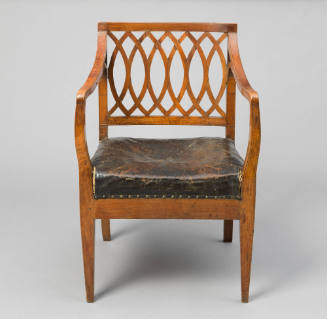
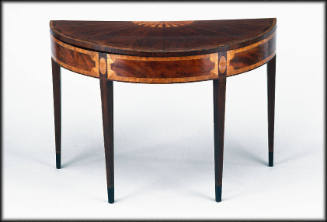
1795-1810
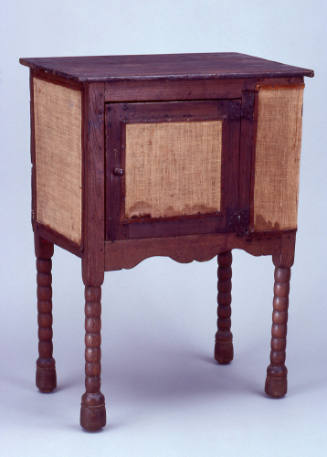
1680-1720
1745-1765
ca. 1700
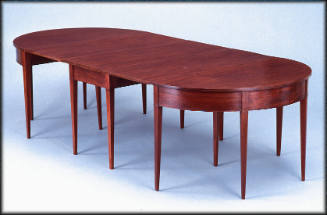
ca. 1795
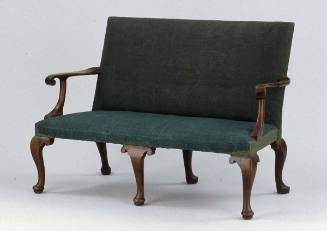
ca. 1730
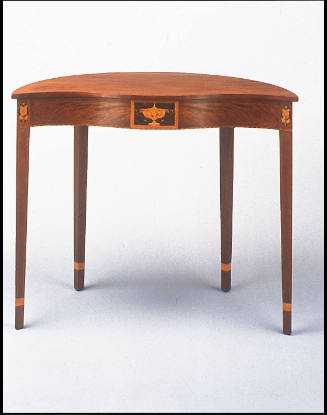
1795-1805
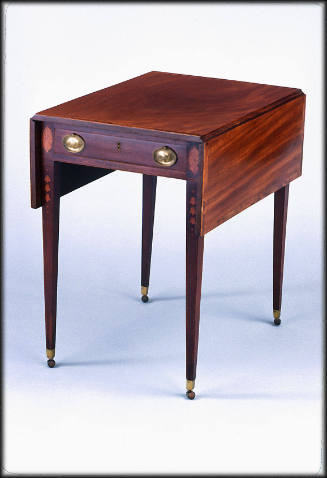
1790-1800
1745-1760