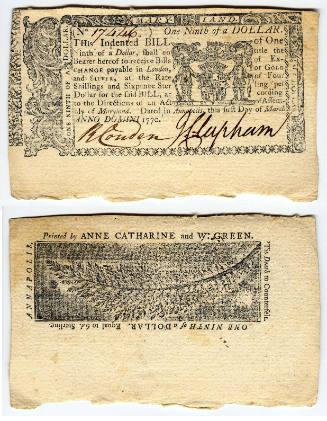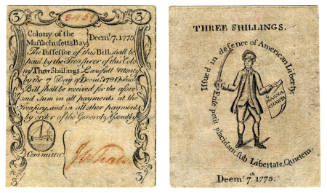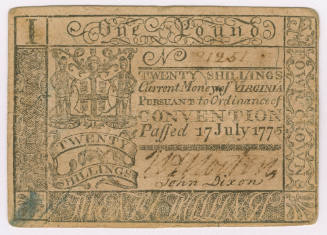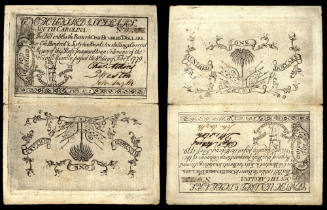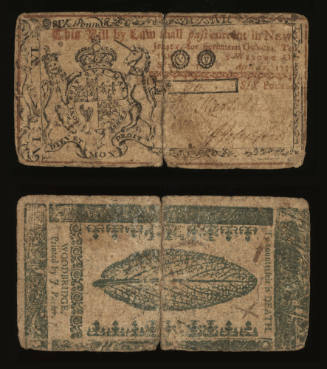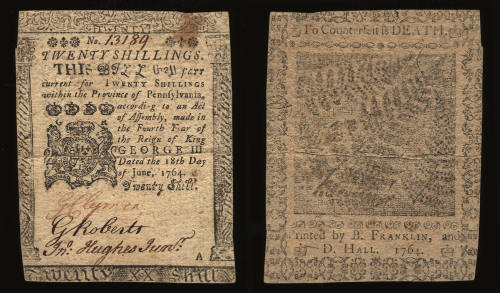
Pennsylvania, 20 shillings note
DateJune 18, 1764
Printer
Benjamin Franklin and David Hall
MediumPaper & ink
DimensionsWidth: 2 3/4" Height: 3 1/4"
Credit LineGift of the Lasser Family
Object number1994-210,745
DescriptionCurrency. "TWENTY SHILLINGS. THIS BILL shall pass current for TWENTY SHILLINGS within the Province of Pennsylvania, according to an Act of Assembly, made in the Fourth Year of the Reign of King GEORGE III. Dated the 18th of June, 1764. Twenty Shill." British arms on front; nature print on back and "To Counterfeit is DEATH. Printed by B. FRANKLIN, and D. HALL. 1764."Label TextAmong the United States' founding fathers, Benjamin Franklin stands out not only as a brilliant, talented statesman and ambassador but also as a clever inventor and designer. Clearly understanding the symbolic and functional importance of a new nation's currency, he was also involved in many different aspects of numismatics.Trained as a printer, Benjamin Franklin got his first commission to print paper money in 1731. By 1739, the notes he was producing for the colony of Pennsylvania were double sided, and they included a naturalistic representation of a different leaf on the reverse of each denomination. Produced by a complicated secret process, Franklin's "nature prints" were used as an attractive anti-counterfeiting device on the backs of a number of different colonies' notes, and those of the Continental Congress, until around 1780.
Mark(s)Signatures: "G Clymer, G. Roberts, Jno. Hughes, Junr. Serial Number: "13189".
April 1, 1773
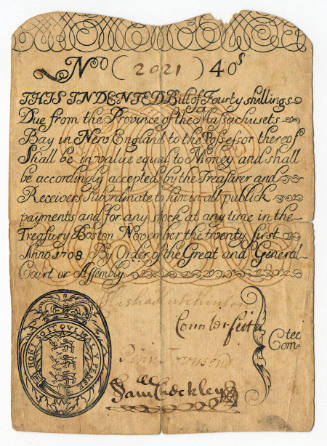
November 21, 1708