
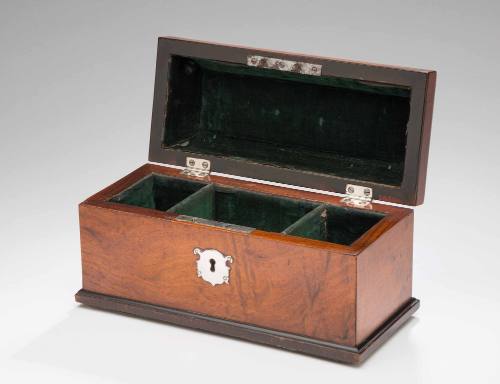
Chest
Date1741-1742
Marked by
Elizabeth Godfrey
active 1741-1771
OriginEngland, London
MediumMahogany; silver (sterling)
Credit LineMuseum Purchase
Object number1937-153,4
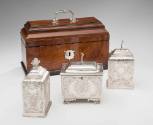
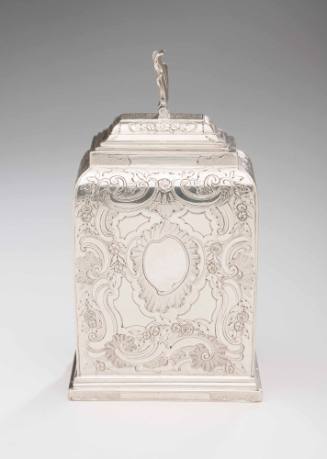
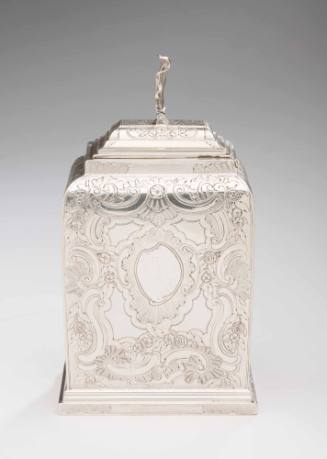
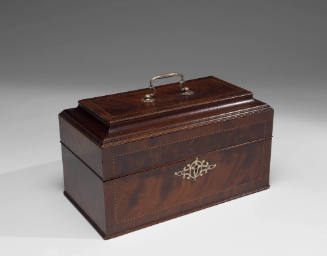
DescriptionMahogany tea chest with set of two silver tea canisters and one silver sugar box. Oblong rectangular mahogany case internally divided into three compartments for caddies and lined with green velvet; case fitted with silver bail handle on top and silver keyhole escutcheon on the front side.Label TextTea canisters were often made in pairs with a larger and matching sugar box and fitted in a lined chest, usually of finished wood or covered with shagreen. George Washington, writing to Lafayette in 1783, ordered, along with numerous plated articles, "1 Tea chest, such as usually appertains to tea or breakfast tables, the inner part of which, to have three departments, two for tea's of different kinds, the other for Sugar." The term "tea caddy" is commonly used today for both the "tea canister" and the "tea chest," as they were generally referred to in the eighteenth century. George Hepplewhite, in his Cabinet-Maker and Upholsterer's Guide (London, 1788), illustrates three "Tea Chests" and three "Tea Caddies." His is one of the earliest uses of the latter term, by which he distinguished small tea chests with only one or two compartments from larger examples. Thomas Sheraton, in his Cabinet Dictionary (London, 1803), states that "This word ['Cady'] is now applied to various kinds of tea chests, of square, octagon and circular shapes," again alluding to the smaller type, sometimes lined with sheet lead and not fitted with separate canisters.This set is handsomely flat-chased with rococo scroll, shell, and floral ornament framing cartouches on some of their sides. The protective chest is undoubtedly largely responsible for their crisp condition. The pieces exemplify the fine work produced in the shop of Elizabeth Godfrey, who deserves to be considered the preeminent woman silversmith of the eighteenth century. The daughter of Huguenot silversmith Simon Pantin, she twice registered her own marks at Goldsmiths' Hall. Her first mark was recorded as Elizabeth Buteux in 1731 after the death of her first husband, the silversmith Abraham Buteux. Her second mark was registered as Elizabeth Godfrey in 1741, the year this set was made. She continued after his death the business of her second husband, Benjamin Godfrey, whom she had married in 1734. She maintained the firm until the end of her life in 1771.
Inscription(s)Arms of an unmarried lady of the Gregory family, Nottinghamshire and
Lincolnshire, engraved on front of body and on either end of sugar box and on one end of both tea canisters; arms erased at an early date from within chased cartouche on bodies of both tea canisters and beneath present arms on front of sugar box.Mark(s)Marked in relief: 1) "EG" in block letters with double-lobed device above and a bell flower below within a lozenge [Grimwade 1990 # 591]. See object file for additional information.ProvenanceJames Robinson Inc., New York. Acquired by CWF in 1937
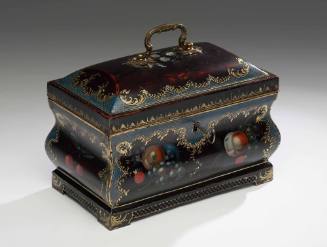
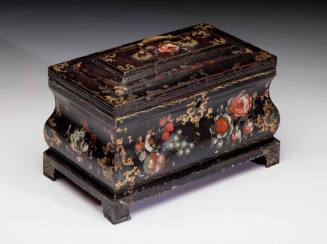
1755-1770
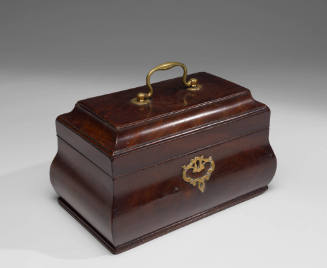
1740-1760
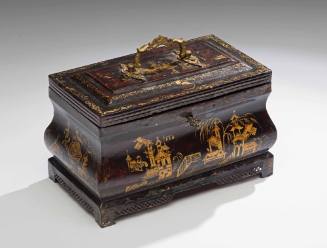
1770-1790
1775-1800
ca. 1770
1765-1785
1750-1760
1740-1770