
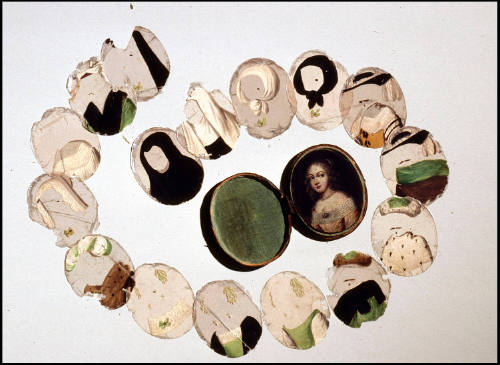
Mica overlays (16) for miniature portrait
DateProbably 1650-1670
MediumOil on mica
DimensionsOval, each approximately: 2 1/2 x 2in. (6.4 x 5.1cm)
Credit LineMuseum Purchase
Object number1995-23,3A-P
DescriptionSixteen small ovals of thin sheets of transparent mica, overpainted in oils with various costumes, to be laid over a bust-length miniature portrait of a woman to change the sitter's appearance. The individual overlays are: (A) a black cloak and black hood, (B) a white wimple [?] and white hood, (C) a white head scarf and green bow tie, (D) a black head scarf and green bow tie, (E) a Cavalier-type male outfit of brown doublet, lace collar, and black, broad-brimmed, feather-trimmed hat and, for the face, a moustache, (F) a green and brown cloak with a hat similar to the preceding and another moustache, (G) an ermine-wrap and turban, the latter with a green scarf or ribbon in the top, and a moustache and goatee for the face, (H) a turban similar to the preceding with a black and green cloak and a moustache and goatee for the face, (I) a dress with a green bodice and brown sleeves, ringlets of hair at the side of the head, and earrings, (J) a dress with a green bodice, lace-trimmed top, and black sleeves, the hair and earrings similar to the preceding, (K) a dress with a wide band of lace at the top, the hair and earrings similar to the preceding, (L) a brown-spotted wrap worn with a twisted green and brown turban, (M) a lace head covering, earrings, and a black clasp on the dress, (N) a brown cloak with a square, decoratively-trimmed collar, (O) a green wrap or dressing gown with very wide black lapels worn with a beige [turban?], and (P) a black head scarf, earrings, and a bow brooch.Label TextA fair number of miniature portraits with accompanying mica overlays survive. In the manner of clothing modern day paper dolls, the overlays can easily be removed and replaced to alter the subject's appearance. Charles I (1600-1649) was the portrait subject of many of these seventeenth-century transformation sets, the overlays placing him in contexts immediately before and after his execution. In other sets, the portrait shows a female subject that can be identified as Henrietta Maria (1609-1669). In still other instances, however, the subject of the portrait is likely fanciful, which seems to be the case with CWF's example.
The execution of Charles I may have initiated (or, more likely, popularized) a fad for such sets. Yet clearly some, particularly those featuring fictitious subjects, were fabricated for the simple sake of amusement. Many overlays for female subjects, like some of CWF's, show the women "en travesti" (dressed as men).
Mica is a naturally occurring mineral that can be cleft into thin transparent sheets. Because of the fragility of these laminae, however, few or no transformation sets survive with their full complement of overlays. As many as twenty-four may have accompanied some images of Charles I; CWF's set includes sixteen.
Although the overlays alter the look of the base subject in a manner similar to modern paper doll outfits, some seventeenth century overlays include larger contexts, such as draperies, accoutrements, backgrounds, and even the faces of other figures. Some, if not all, of these sets were produced in Holland.
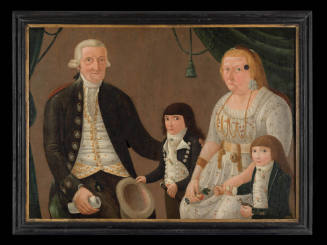
ca. 1795
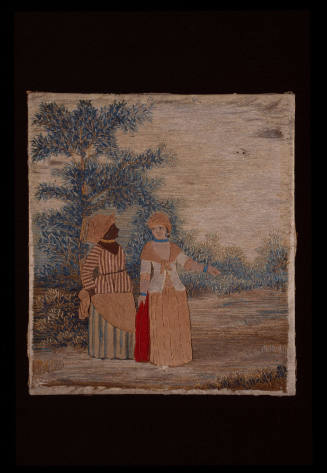
Ann Culpepper Fairfax
ca. 1805
Francis Cotes
Probably 1764-1768
Joseph H. Davis
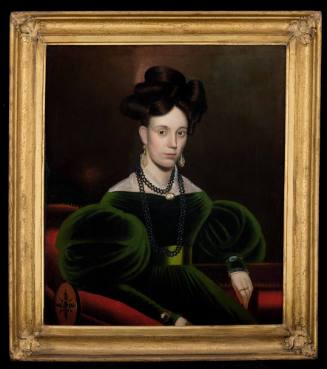
1834
Thomas Jefferson Wright
1831