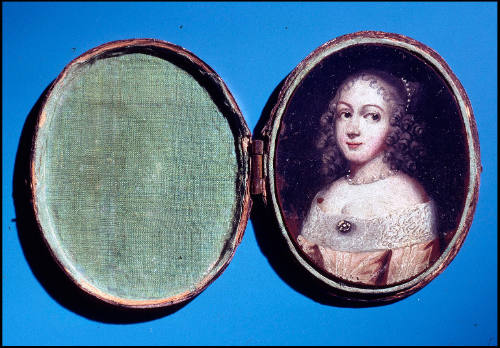
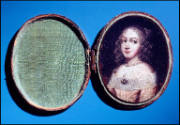
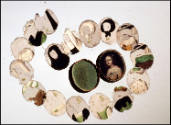
Miniature portrait of a woman
DateProbably 1650-1670
MediumOil on copper
DimensionsOval primary support: 2 1/2 x 2in. (6.4 x 5.1cm)
Credit LineMuseum Purchase
Object number1995-23,1
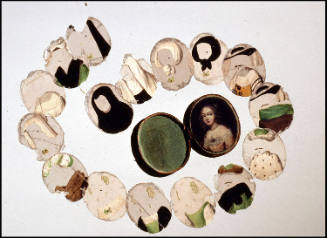
DescriptionA miniture bust-length portrait of a woman in a pink dress with wide, white lace trim at the top; she wears a single string of pearls, a brooch, and has pearls in her curly, long, light brown hair. For descriptions of the accompanying case and overlays, see their separate entries.Label TextA fair number of miniature portraits with accompanying mica overlays survive. In the manner of clothing modern day paper dolls, the overlays can easily be removed and replaced to alter the subject's appearance. Charles I (1600-1649) was the portrait subject of many of these seventeenth-century transformation sets, the overlays placing him in contexts immediately before and after his execution. In other sets, the portrait shows a female subject that can be identified as Henrietta Maria (1609-1669). In still other instances, however, the subject of the portrait is likely fanciful, which seems to be the case with CWF's example.
The execution of Charles I may have initiated (or, more likely, popularized) a fad for such sets. Yet clearly some, particularly those featuring fictitious subjects, were fabricated for the simple sake of amusement. Many overlays for female subjects, like some of CWF's, show the women "en travesti" (dressed as men).
Mica is a naturally occurring mineral that can be cleft into thin transparent sheets. Because of the fragility of these laminae, however, few or no transformation sets survive with their full complement of overlays. As many as twenty-four may have accompanied some images of Charles I; CWF's set includes sixteen.
Although the overlays alter the look of the base subject in a manner similar to modern paper doll outfits, some seventeenth century overlays include larger contexts, such as draperies, accoutrements, backgrounds, and even the faces of other figures. Some, if not all, of these sets were produced in Holland.ProvenanceOwnership prior to Huber (CWF's source) is unknown
Probably 1838-1842
ca. 1795
Probably 1650-1670
1800-1801 (possibly)