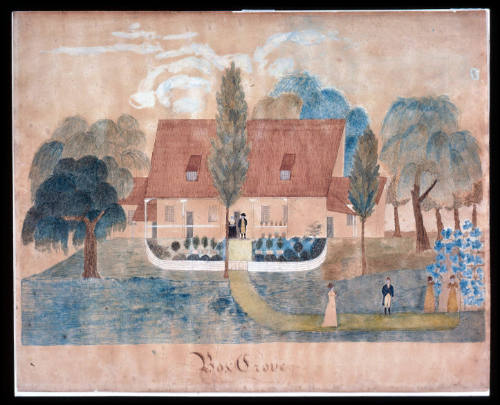
Box Grove
Dateca. 1800
Attributed to
Amy Cox
(active ca. 1800)
MediumWatercolor, gouache, and pencil on wove paper
DimensionsFramed: 17 1/4" x 20 1/4" Unframed: 13 11/16" x 17 1/4" (35.1 x 43.8 cm.)
Credit LineMuseum Purchase
Object number1971.301.1
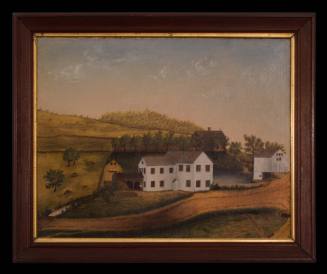
DescriptionA bottom margin of about 1 3/4" is left unpainted, and in the center of this margin appear the words, "Box Grove," the name of the house depicted in the painting. The house is painted with an impossible perspective, being seen from head-on and slightly from the right side simultaneously. It is carefully centered on the sheet of paper. It has columns across the front (which, on the right, seem to disappear behind a wall of sorts) with--at least across one section--potted plants set out on the edge or crossbar between two columns. Other potted plants are set out on the ground beneath these. Four windows and two doors are visible on the colonnaded front, but wings project from either side of the house and also smaller porches off these wings. There are two dormer windows visible in the main section of the house. A brick chimney at the left end of the roof line has been sketched in with pencil and some faint watercoloration appears in it, but it does not apear to have been finished. The main body of coloration appears in it, but it does not appear to have been finished. The main body of the house is left unpainted and appears the dark tan color of the support, through the columns and fence & gate in front of house are white. The roof is a dark reddish-tan--perhaps suggestive of red tiles-- with divisions between individual tiles--or whatever units of building material--painted in vertically to the sheet edges rather than parallel with the roof edges. A white fence encloses a small garden in front of the house; shrubbery is planted around the fence inside it, and other shrubs are visible in boxes set out on the ground inside the fenced area.The house is situated in a grove of trees, many of which have the configuration and small arrow-like drooping leaves of willows, though bushier than usual willow depictions. Two tall poplar-like trees are in front of the house, one directly beside the front gate. Some white clouds are in the sky above the house. Much of the grass in front of the house is striated to give an appearance of texture, but the path leading from the front door down to the front of the picture then curving off to the right is a solid, more yellow-green. At the end of the path as it terminates at far right stand two girls under a tall grape arbor, only one end of which is visible. The large leaves and grapes are painted blue. One of the girls has her back to the viewer and is plucking from the arbor; the other faces directly outward, one arm to her waist and the other hanging by her side. The girls are the same size, dressed alike, and are said to be twins (see "Reference") . Further up the path, between the house and the girls, stands a young man dressed in knee boots, tail coat, etc. He holds an object in his proper left hand, hanging by his side. Though this object's identity remains unclear, it might be a hankerchief. He is said to be the twin's brother and son of the couple standing in the house doorway (again, see "Reference"). Still further up the path, coming toward the man, is a young woman in a high-necked empire-waisted dress with blonde hair piled on top of her head, her far arm raised as if in greeting. In the doorway of the house, side by side, stands a couple, an elderly woman in plain black dress with white gathered bands (or possibly a shawl) over the front. He wears knee boots, long coat and a cocked hat, and he holds a cane in his proper right hand.
Period replacement 2-inch, cove-molded gilded frame.Label TextThe flattened perspective, pleasing juxtaposition of blue and green foliage hues, prominently place grape arbor, and animated figures add great charm to this picture. Yet BOX GROVE is more than an appealing, amateurish rendering of the period. The surmise that it was drawn on location enhances its value as a social and historical document, telling us much, for instance, about architectural styles, landscape planting, and domestic values of about 1800. Note that the enclosed yard is crammed with shrubbery, some of it in tubs. A simple, waist-high railing crosses the porch front and supports a row of potted plants
According to family tradition and late-nineteenth century documentation, the figures on the porch at Box Grove are identified as Brigadier General James Cox (1753-1810) and his wife, Ann Potts Cox (1757-1815), while the young man on the walk is their son Thomas. The woman advancing toward Thomas is variously described as his sister and his fiancée. The girls at far right are the Coxes' twin daughters, Mary and Amy, born in 1783. Family descendants firmly believe the latter to have been the artist of this watercolor, although as yet, no other works by her are known, nor is there period documentary substantiation for the assertion. Box Grove was located near Imlaystown in Monmouth County, New Jersey.Mark(s)"Box Grove" is lettered in the margin below the composition.ProvenancePurchased from a family descendant. AARFAC purchased from a direct descendent of one of teh pciture's subjects, Brigadier General James Cox (standing by his wife in the doorway). The assumption is that the painting has never, until AARFAC's purchase, been out of the family. (See letter, William Meirs to PAGB 11/20/69).
Late 18th - early 19th century
Probably 1857-1865
Probably 1845-1875