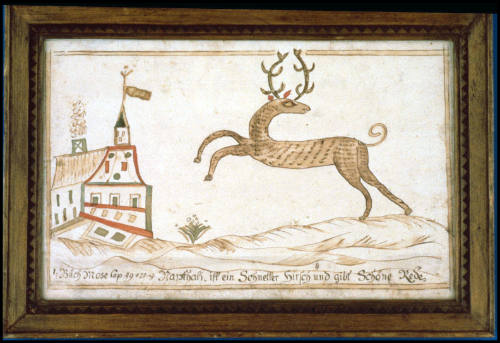
Napthali
Dateca. 1770
Attributed to
Daniel Schumacher (ca. 1729-1787)
OriginAmerica, Pennsylvania
MediumWatercolor and ink on laid paper.
DimensionsPrimary support: 7 3/8" x 11 7/8" and Framed: 9 1/2" x 14"
Credit LineMuseum Purchase
Object number1961.305.3
DescriptionA picture of a deer running across a slope toward a distant building flying a pennant. The deer runs toward the viewer's left but its head is turned to look behind it. Text appears along the lower border.The 1 1/4-inch unpainted molded wood frame with a 1/4-inch chip-carved inner edge is possibly a period replacement.Label TextThe style of the inscription across the bottom of the drawing as well as the loose, attenuated rendering of forms support an attribution to Daniel Schumacher. No other similar works by his hand or by other fraktur artists have been located.
One early fraktur scholar, John Joseph Stoudt, interpreted this deer as a symbolic representation of the Apocalypse, basing much of his theory on Jacob Boehme's explanation of the testament of Jacob as published in MYSTERIUM MAGNUM [note 1]. The testament gives allegorical meaning to each of Jacob's sons. Napthali, the tenth son, represented the "time of great wonder," when the Anti-Christ would appear. Stoudt believed that Napthali, the hind as shown here, was raising his hooves to pound an "erupting, trembling earth, and the houses of disputation" [note 2].
Stoudt's theory is difficult to support for several reasons [note 3]. In the eighteenth and nineteenth centuries, leaping deer, stags, and hinds frequently appeared on decorated household items made and used by German Americans with no overt reference to the Apocalypse. As a Christian symbol, the religious significance of the motif was sometimes explained by accompanying inscriptions. But here, as elsewhere, the symbolic inference probably goes no further than a literal translation of the inscription. Given Schumacher's background as a minister, one would not expect him to render the Apocalypse as subtly as this, where the deer gracefully leaps over an otherwise tranquil and nondescript plain. Although the church building at left is distorted, it evokes no negative sensation as Stoudt claimed. Schumacher, one of the earliest American fraktur artists, was not a gifted draftsman. The poor perspective and alignment of the building may reflect nothing more than his lack of drawing skill.Inscription(s)Written in script in ink in German at the bottom of the fraktur is "I. Buch Mose Cap 49 v.21--- Napthali ist ein Schneller Hirsch und gibt Schone Rede."
The English translation reads: "Genesis (I Moses) 49:21 Napthali is a fast deer and gives beautiful words."Mark(s)An unidentified watermark in the center of the primary support includes a crown with circles enclosing several fleurs-de-lis and an animal that resembles a pig.ProvenanceHerbert Schiffer, Whitford, Pa.
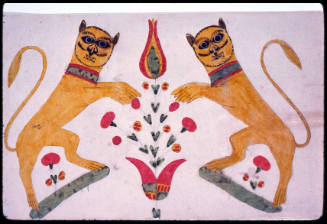
John Van Minian (active ca. 1790)
ca. 1820 possibly (see n. 2)
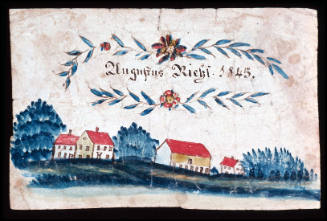
The Ehre Vater Artist (active ca. 1782-1828)
ca. 1807
The Sussel-Washington Artist (active ca. 1760-1779)
ca. 1780
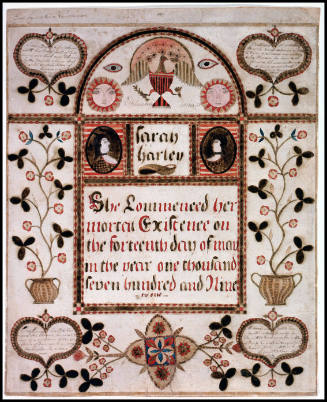
Friedrich Krebs (1749-1815)
ca. 1799 (probably)