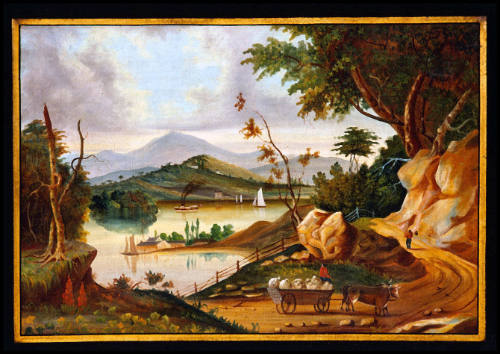
View of Newburgh
Date1830-1845 (probably)
After work by
William Guy Wall
1792 - after 1864
OriginAmerica
MediumOil on canvas
DimensionsFramed: 33 7/8" x 46 7/8". Unframed: 33 1/8" x 46" (84.1 cm x 116.8 cm).
Credit LineMuseum Purchase
Object number1958.102.22
DescriptionView of Hudson River. In the foreground is a dirt road winding off up to the right. On the road are two oxen pulling a cart (four wheels) driven by a man in a red shirt, blue pants and black hat. The wagon carries large bags of something. Further along the road is a man in similar garb carrying a sack on a stick over his shoulder. In the lower left foreground is some disproportionately large ivy on ground and a young sycamore type tree without leaves. A wooden fence separates the the road from the drop down to the river bank. A large boulder stands between the road and the fence on the right. A point of land juts out into the river. Several houses stand on it, and some cypress trees and several sailing vessels are docked beside it. Sailing down the river is a side-wheeler steamboat, and two sailing vessels. On the far side of the river (the river goes roughly parallel to the picture frame) is a farm house and hills that rise up into the mountains. Some other houses are visible in the hills. The colors tend to be orangish brown in the foreground, and even the river has a yellowish cast. The picture is surrounded by a thin band of black paint and a thicker band of gold paint. Framing these two bands is a large 2 3/4" band of black paint.Label TextThis painting is clearly based either on William Guy Wall's 1820 watercolor view of Newburgh, New York, or more likely, on a print after Wall. John Hill's engraved rendition, published in 1825 as plate number 14 of the HUDSON RIVER PORTFOLIO, followed Wall closely, and Hill's work may have served as the unidentified oil painter's model. However, in at least one respect, the oil is compositionally closer to period views of Newburgh transfer-printed on Staffordshire china and also based on Wall; like the oil, the transfer prints incorporate a strong vertical thrust of rock, earth, and foliage at left foreground, thereby partially enclosing the vista in a tighter more self-contained format than either Wall's or Hill's depictions, which are open to the left.Features that are not noted in recorded printed views of the subject and that appear to have been added by the painter of this image include the steamboat, towering mountains, and mid-river island. In a further departure, the unidentified artist deleted the town of Newburg, which in the original and in derivative prints appears on the far shore, just below center in the picture plane.
Newburgh declined when development along the Erie Canal diverted its commercial growth, but establishment of a thriving whaling industry revived it in the 1830s and 1840s. This romanticized scene probably dates from the town's period of renewed vitality.ProvenanceJ. Stuart Halladay and Herrell George Thomas, Sheffield, Mass. Halladay died in 1951, leaving his interest in their jointly-owned collection to his partner, Thomas. Thomas died in 1957, leaving his estate to his sister, Mrs. Albert N. Petterson, who was AARFAC's vendor.
ca. 1850
Probably 1857-1865
Probably 1845-1875
ca. 1875
ca. 1850