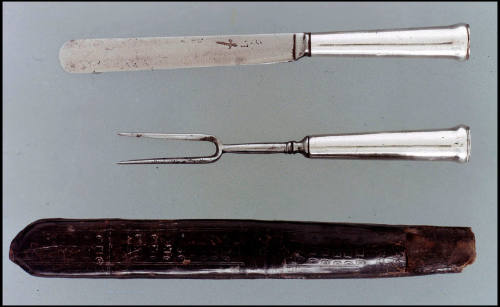
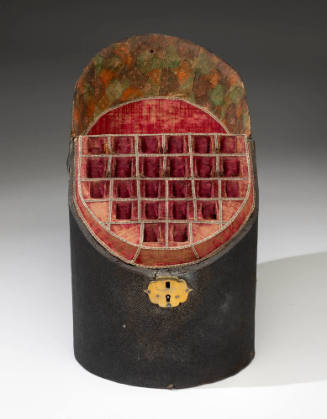
Knife and fork with sheath
Dateca. 1690
OriginEngland, London
MediumLeather
DimensionsL (case):6 3/8"
Credit LineMuseum Purchase
Object number1972-323,3
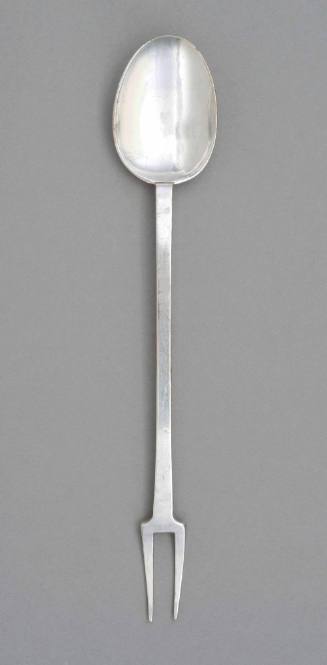
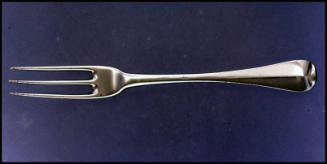
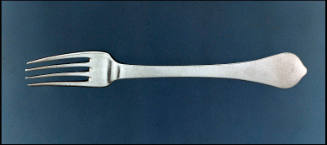
DescriptionSheath for fork and knifeLabel TextKnives and forks with matching silver handles and steel blades and tines first appear in the reign of Charles II. These seal-end examples are of the earliest type, characterized by a tapering tubular handle of circular section with a bulge before a flush end. Their handles, unlike later cast and stamped ones, are wrought out of a strip of silver with a single seam running lengthwise and a flat disc soldered to and forming the end. They were fashioned by an unidentified London small-plate worker, whose mark appears on other flatware handles and small accessory items, such as nutmeg graters. Like most forks of this type and date, this example has two rather long slender tines. The knife blade with nearly parallel edges is original. During the late seventeenth century, curved blades of early scimitar form were being introduced. The blade bears the dagger mark of the London Cutlers' Company, which was struck on London knife blades after 1607and soon was misappropriated by some Sheffield and Birmingham cutlers. Sheathed knives and forks probably served as personal traveling accessories. Pairs of knives in sheaths, however, were common wedding presents during the late sixteenth and seventeenth centuries.William Fitzhugh of Stafford County, Virginia, ordered from London in 1688 a set of silver flatware, including "One dozen silver hafted knives. 1 doz: silver forks One dozen silver spoons large & strong." There were difficulties in processing the order, and he reminded his London agent the following year that he still desired "a Case containing a dozen hafted knives, & a dozen silver hafted forks." These he apparently obtained, for "1 Dozn. Silver hafted Knives 1 Dozen Silver Forks. . . 1 Doz: Silver Spoons" are listed in the 1703 inventory of his estate. The knives and forks probably had handles of this seal-end type.Inscription(s)NoMark(s)NoProvenanceVendor: How (of Edinburgh), London
ca. 1690
ca. 1690
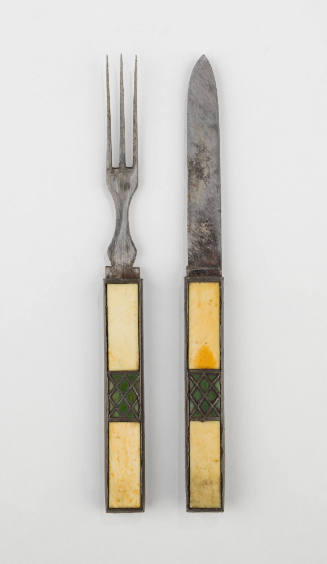
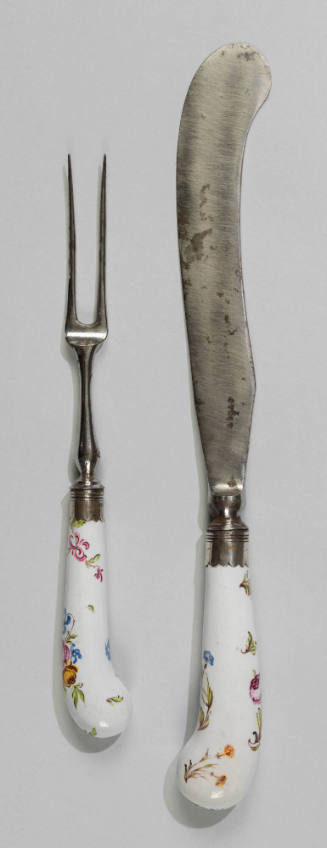
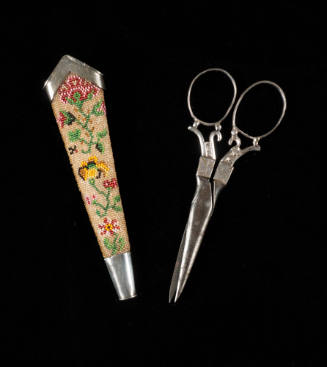
1810-1825
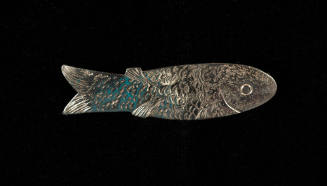
1800-1820
1745-1765