


Dressing table
Date1730-1740
MediumBlack walnut, birch, and white pine
DimensionsOH: 32 1/4" OW: 33 7/8" OD: 21 1/2"
Credit LineMuseum Purchase
Object number1972-229
DescriptionApperance: Dressing table with broad, flat top with rounded edge on all four sides; the top is elaborately veneered with center section divided into four panels of crotch veneer surrounded by a double band of herringbone pattern veneer. Beyond is a border approximately 1 1/2" wide of plan veneer which is, in turn, bordered on the edge by a second double strip of herringbone veneer. The top overhangs the case on the sides and back by approx. 2" and on the front by approx. 1 3/4". Straight sides, each side veneered with a double panel with a seam down the center. The area above each leg is veneered separately. Front is composed of five drawers, two horizontal drawers at the top above 2 "square" drawers below which flank a smaller horizontal center drawer. Three lower drawers are each veneered with a central panel surrounded on four sides by a double row of herringbone veneer. The top drawers are similarly faced but lack the herringbone border at the top. The drawers are outlined by a double bead molding on all sides except the top of the top row of drawers. Area below the bottom drawers is faced with a crotch veneer. The front skirt is deeply scalloped with flat arches beneath each of the side drawers and a deep reverse ogee arch beneath the center drawer. Each drawer contains a single engraved Queen Anne brass with bail, all original. The skirt is bordered by an applied strip of bead molding nailed to the underside. A pair of replaced acorn drops extend downward from lowest projections of skirt. The side skirts are shaped in a flat-headed, shallow arch and are also bordered at bottom by the applied bead molding. Table is supported on four extremely thin and graceful birch cabriole legs with pointed knees, each terminating in an almost circular pad foot on a slightly molded disc.Construction: Backboard is tenoned and pegged to rear legs. Side boards are tenon to front and rear legs and veneered. Front skirt (with chamfered inner lower corners) is tenoned and pegged to front legs and veneered. Bead along bottom edge of sides and front skirt is nailed with rosehead nails to underside of same elements. Rectangular vertical dividers between lower drawers are nailed to the sides of the projecting vertical portion of the front skirt and tenoned into the backboard. Three-quarter depth dust board is nailed to the tops of these vertical dividers with two nails each and appears to be in a notch in the rear corner of the front legs. Drawer guides flanking the upper drawers may originally have been glued to inside of the case sides and tops of the dust boards. Vertical divider between the top drawers is (nailed?) in a dado in the top of the dust board and tenoned into the case backboard. Lower drawers are each supported by single front to back drawer support in the center of each drawer, lapped over edge of drawer opening and tenoned into backboard. Walnut facing of drawer openings, with double bead, butt joined to front of white pine dividers and dust board, and set into the edges of the drawer openings in the front skirt and along the sides. Top interior corners of rear legs chamfered slightly. Drawer stops glued to backboard. Drawers are standard dovetail construction with front to back oriented bottom board nailed to underside of sides, back, and in rabbet in underside of front. The drawer sides and backs are finished with a double arch molding. Original brass drawer pulls held in place with brass cotter pins.Label TextNew England craftsmen continued to produce baroque dressing tables longer than most of their colleagues in other American cabinetmaking centers, but rarely did they surpass the heights of design and detail to be found on this early Boston example. The interplay of book-matched veneers and herringbone inlays, the sinuous quality of the cabriole legs, and the elaborately shaped skirt all serve to heighten this table’s sense of controlled richness.
Few New England dressing tables of this quality have survived in such original condition. Here the brasses, veneers, and framing are essentially intact; only the drops have been replaced.Inscription(s)Chalk numerals on sides and interior of backs of some drawers. Most commonly identified numeral was "4". Chalk marks on backboard.
Some drawers are numbered on bottom in modern green crayon.ProvenanceFormerly Smith Collection, Winchester, Massachusetts.
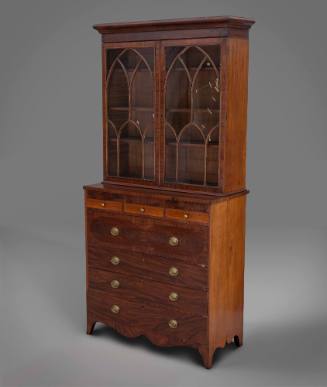
1800-1815
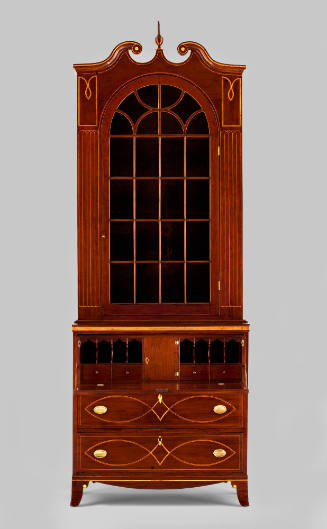

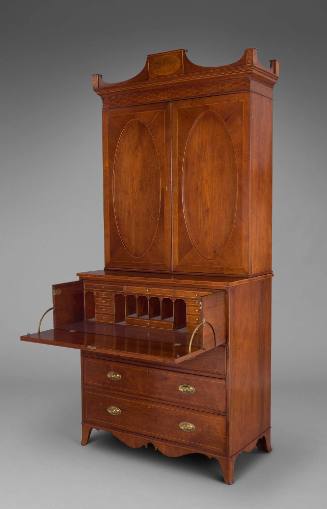
ca. 1800

1735-1755

1815-1820


ca. 1800
ca. 1770
