
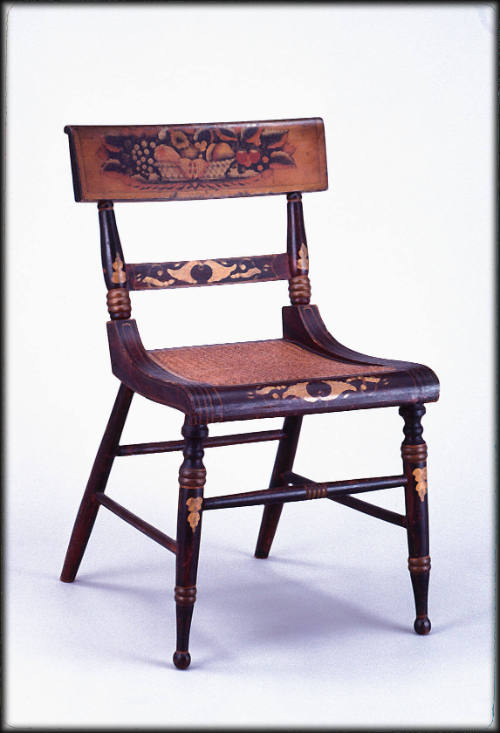
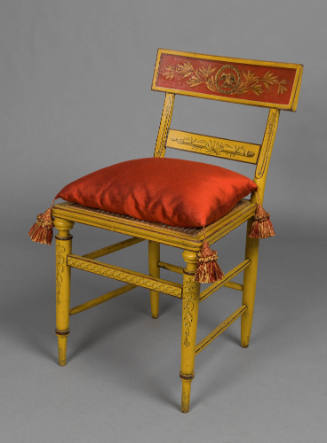
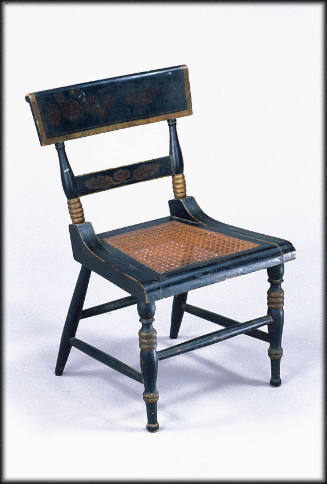
Side chair, klismos
Dateca. 1825
MediumMaple throughout, grained and stenciled.
DimensionsOH: 31 1/8"; OW: 17 1/4"; OD: 15 3/8"
Credit LineMuseum Purchase
Object number1993-175,1
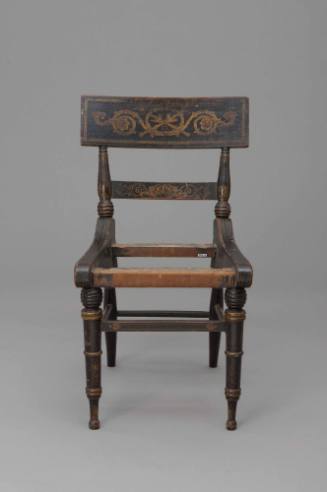
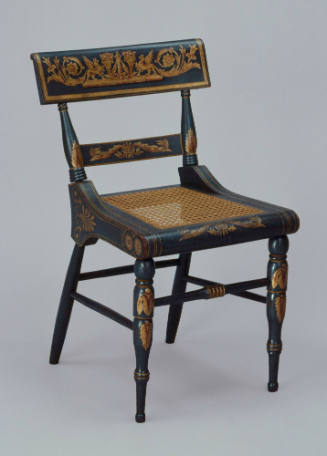
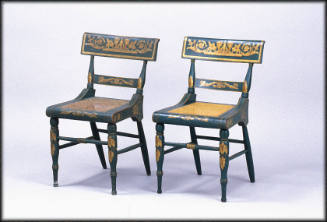
DescriptionSide chair, one of a pair. APPEARANCE: klismos style chair; concave tablet-form crest rail with applied half-round molding on reverse at top; concave rectilinear stay rail; turned stiles; L-shaped outer side seat rails; front seat rail with rounded profile; caned seat; turned legs; turned box stretchers. Painted decoration consisting of gilt and polychrome stencils with minor freehand ornamentation in black; ground grained in imitation of rosewood; yellow caned seat. CONSTRUCTION: crest rail molding set with cut nails; stiles round-tenoned into crest rail and other side seat rails; stay rail tenoned into stiles; inner side seat rails tenoned into front and rear seat rails; outer side seat rails glued to resulting seat frame; lower edge of front seat rail applied with cut nails; legs round-tenoned into outer side seat rails; stretchers round-tenoned into legs.Label Text“Fancy” furniture, so called because of its inventive and imaginative decoration, was produced in coastal cities from New England to South Carolina, but the fast growing city of Baltimore was the undisputed capital of the country’s painted-furniture industry. The most elaborate Baltimore chairs featured gilded and stenciled classical designs enhanced by freehand application of paints and tinted varnishes meant to simulate the costly gilt bronze mounts on European furniture. Less expensive chairs, like this example, omitted the freehand painting in favor of unembellished single or multi-color stenciled decoration. The use of stencils made it possible to easily replicate the same motif on multiple pieces of furniture. A handful of stencils for one motif allowed a variety of colors, created with bronze, brass, zinc, aluminum, silver, and gold powders, to be applied, providing an elegant appearance.Mark(s)Modern gummed label on bottom of left seat rail inscribed "#4026" in felt-tipped pen; modern gummed label on bottom of right seat rail inscribed "Fendelman M133490" in typescript and "185/2" in ball-point pen.ProvenanceBarry Cohen, New York; Lewis Scranton, Killingworth, Connecticut; Burton and Helaine Fendelman (collectors), Westchester County, New York; sale of Fendelman collection, Sotheby's, New York, 23 October 1993; purchased for Colonial Williamsburg at sale (bidding by Sumpter Priddy).
1755-1775
1825-1835
1730-1765
1730-1765
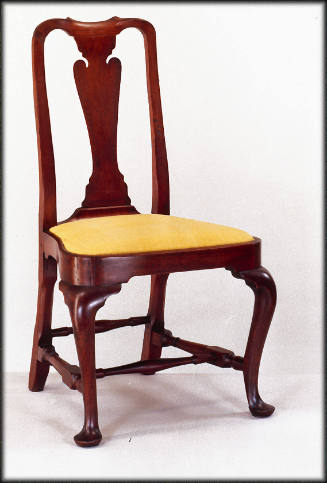
1730-1765