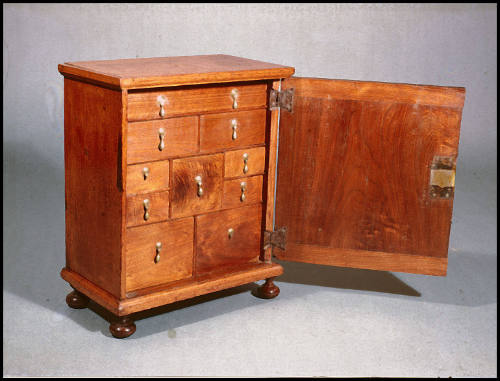
Spice box
Date1720-1740
MediumBlack walnut, tulip poplar and white cedar
DimensionsOH: 20 1/2"; OW: 17"; OD: 9 1/2"
Credit LineBequest of Elizabeth Ridgely Blagojevich.
Object number1991-370
DescriptionAppearance: Spice chest with applied moldings around top and base on turned compressed ball or bun feet; single large door with brass escutcheon and battens across top and bottom attached to case with original iron butterfly hinges opens to reveal interior cabinet composed of one long drawer (replaced - originally had two small drawers) over two small drawers over a center square drawer flanked by stack of two smaller drawers on each side, over two deep drawers, all with brass tear-drop pulls (pulls on all but top drawer are original); shallow secret drawer accessed from back of center drawer.Construction: The single board walnut sides are half-blind dovetailed to the single board walnut top and dovetailed to the single board yellow pine bottom. The white cedar two board (butt joined) back is nailed into rabbets in the side and top, and from the back into the edge of the bottom. A 1/8” x 1¾” walnut board is glued to the upper side of the front edge of the bottom, and immediately behind it drawer supports for the two bottom drawers are also glued to the bottom.
Drawer blades and dividers are of 1/8” x 2” walnut, butt joined and glued to full depth yellow pine drawer supports and dividers. They rest in dados in the bottom, sides and each other (and originally in the top, however that divider has been removed when the two top drawers were replaced with one full width drawer).
Shaped and mitered moldings are nailed to the front and side edges of the top and bottom. Turned compressed ball feet are tennoned into the bottom with integral round tenons.
The proper right side is ¾” wider than the proper left side to accommodate a rabbet which receives the door. Butterfly hinges are nailed to the door and inset and nailed to the front edge of the proper left side. The walnut door is tongue and groove joined to top and bottom end-battons.
Drawers are of dovetail construction with walnut fronts and tulip poplar sides and bottoms (with the exception of the replacement top drawer which has a cedar bottom). Bottoms are nailed from the underside into rabbets in the drawer fronts and to the edges of the sides and back. The false bottom of the centermost drawer rests in dados in the sides and is nailed to the bottom edge of the “upper” back. Below it a “hidden” drawer is accessible from the back of the drawer with a now missing leather or textile pull.Inscription(s)"1724" scratched into underside of top. "13 oz 5 dwt" inscribed in ink on a drawer side.
1700-1720
1760-1780
1705-1715
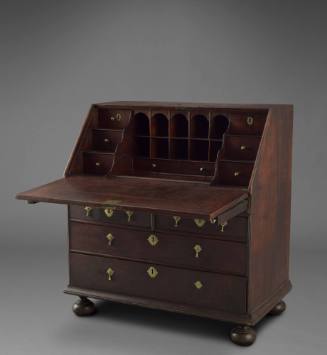
1700-1720
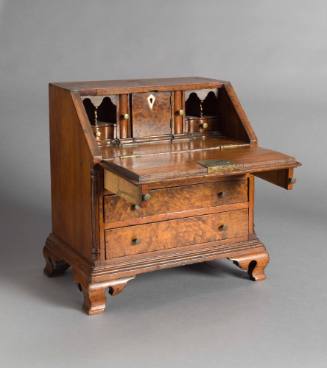
1760-1790
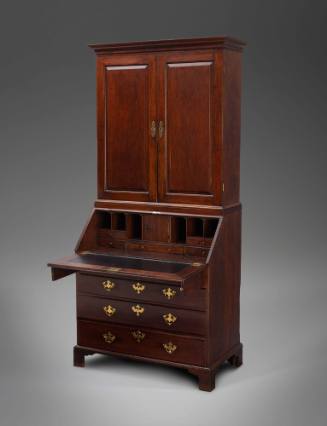
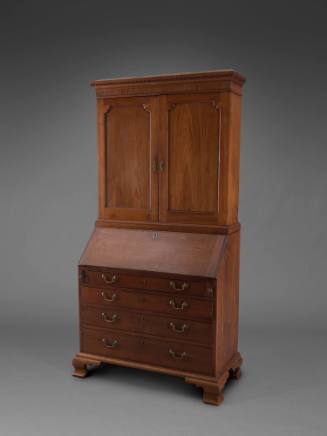
ca. 1785
ca. 1770