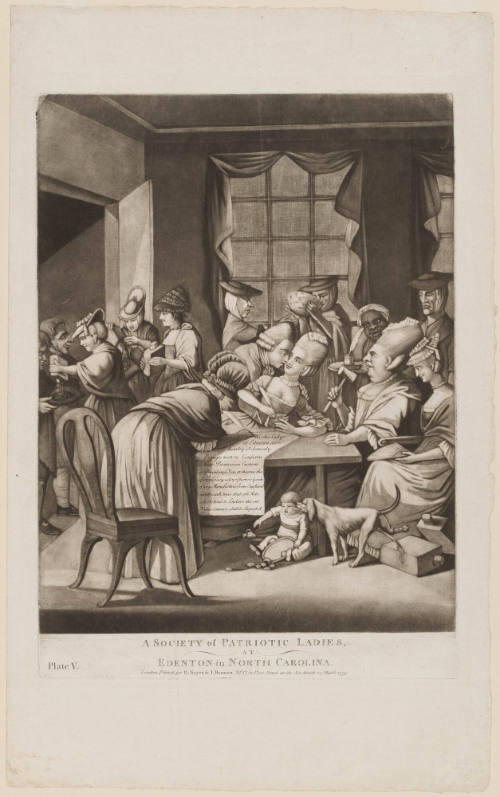
A SOCIETY of PATRIOTIC LADIES, at EDENTON in NORTH CAROLINA.
DateMarch 25, 1775
Attributed to
Philip Dawe
Publisher
Robert Sayer (1725-1794) & John Bennett (fl. 1760-1787)
OriginEngland, London
MediumMezzotint engraving on laid paper
DimensionsOverall: 18 1/2 × 11 1/2 in (46.99 × 29.21cm)
Platemark: 14 × 10 in (35.56 × 25.4cm)
Framed (Rabbet Size): 19 3/4 × 15 1/4 in (50.16 × 38.73cm)
Platemark: 14 × 10 in (35.56 × 25.4cm)
Framed (Rabbet Size): 19 3/4 × 15 1/4 in (50.16 × 38.73cm)
Credit LineMuseum Purchase
Object number1960-132
DescriptionThe lower margin reads: "A SOCIETY of PATRIOTIC LADIES,/ at/ EDENTON in NORTH CAROLINA./ Plate V./ London, Printed for R. Sayer & J. Bennett, N.o 53 Fleet Street, as the Act directs 25 March 1775."The resolve on the table reads: "We the Lady's/ of Edenton do/ hereby solemnly/ Engage to Conform/ to that Pernicious Custom/ of Drinking Tea, or that we the/ aforesaid Ladys will not promote ye wear/ of any Manufacture from England/ until such time that all Acts/ which tend to Enslave this our/ Native country shall be Repealed."Label TextThis print was the last of a series of mezzotint satires published by the London firm Sayer and Bennett commenting on the pre-Revolutionary plight of the colonies. The print depicts the Edenton Tea Party, a group of 51 women in Edenton, North Carolina who, on October 25, 1774, publicly signed a petition resolving to boycott all British imported tea and cloth in the colony. This resolve responded to the Tea Act of 1773, which imposed a tax on British tea at the point of entry in colonial ports. The women’s statement was later published in the Virginia Gazette, the newspaper printed in Williamsburg, Virginia. When their statement traveled to England, residents did not take the Edenton women’s protest seriously, and an engraver created this satirical image to portray the Edenton Tea Party as ridiculous.
In the print, these women crowd around the table to sign the petition, while others the background dispose of the tea in their tea caddies. The engraver depicted some of the women with ugly features, drinking from a punch bowl, being distracted by men, and neglecting a child, to criticize their boycott of English goods and involvement in male-dominated politics.ProvenanceBefore 1960, the Old Print Shop (New York, NY); 1960-present, purchased by the Colonial Williamsburg Foundation (Williamsburg, VA).
ca. 1810
Robert Sayer (1725-1794) & John Bennett (fl. 1760-1787)
1776