Sideboard
Date1790-1805
MediumBlack walnut and yellow pine.
DimensionsOH: 39 3/8"; OW(top): 49"; OW(base): 49 7/8"; OD(top): 29 1/2"; OD(base): 30 1/2"
Credit LineMuseum Purchase
Object number1959-268
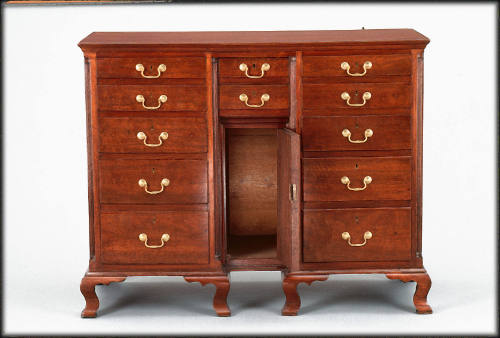
DescriptionAppearance: large bureau table format with molded top; 5 drawers on either side of central section, decreasing in size from top to bottom; central section consists of 2 small upper drawers over lower prospect door with scallop-shaped applied molding, open space inside of door; ogee base molding and tall ogee bracket feet. Construction: The top molding is nailed and glued in place. The butt-joined, two-board top is half-blind dovetailed to the two-board side panels, which are dovetailed to the outer bottom boards. The central bottom board is open-dovetailed to sides of the prospect section. Two horizontal backboards are nailed into rabbets, and both are lap-molded at the center, although it is curious that the boards are set in the same direction so that the edges abut instead of overlapping. The top drawer blade is set into dadoes on the case sides and is backed by a loosely fitted dustboard chamfered along the front edge and set into a dado on the back of the blade, construction that creates a one-inch open space between the upper surface of this dustboard and the underside of the top board. The upper two drawer blades are cut from single pieces of wood and are backed by thin dustboards set into dadoes and secured from below with numerous small wooden wedges. The remaining drawer blades do not span the entire width of the case because of the prospect section. They exhibit the same dustboard construction. All of the dustboards are topped by thin glued-on drawer guides set behind the quarter-columns. The front stiles appear to be open-dovetailed to the case and are faced with fluted quarter-columns whose turned terminals and corresponding plinths consist of separate pieces of wood.
The drawers feature standard dovetailed construction with rounded upper edges on the sides and deep saw kerfs inside the fronts. The bottoms are beveled, set in grooves, and reinforced with small, widely spaced glue blocks along the front and sides. The rear edges of the bottom boards are flush-nailed with wrought sprigs.
Materials: Black walnut top, sides, moldings, drawer blades, stiles, quarter-columns, drawer fronts, prospect door, and exposed parts of feet; yellow pine back, bottom, drawer sides, drawer backs, drawer bottoms, drawer guides, glue blocks, foot blocks, and rear faces of rear feet.Label TextFew pieces of furniture in the CWF collection are more perplexing than this remarkable object. Resembling a bureau table in design, the fifty-inch-wide and forty-inch-tall case is far larger than any other British or American example of the form. The object's size makes it unusable for the dressing or writing functions normally associated with bureau tables. It may have been employed as a sideboard since the height is typical of pieces used for food service and the many drawers and large, undivided cupboard would be ideal for storing flatware, linens, and bulky ceramic or metal vessels. Yet no sideboard of this form is known. The term bureau table will have to suffice until a clearer understanding of the object's original function is determined.
Although its early history is unknown, "Long Meadow" written in chalk on the back and legible only through infrared photography, gives some clue to the origin. Longmeadow is a district in the Valley of Virginia's Augusta County. Several of the structural and stylistic details on the table relate to those on other central valley case pieces. The wavy molding around the door is roughly similar to the inlaid border on the prospect of an Augusta County desk in the CWF collection (acc. 1976-109). The tapered shoulders at the top and bottom of the quarter-columns on the bureau table are akin to those on a tall clock made in Staunton, the seat of Augusta County (acc. 1993-9). The table's tall, ogee bracket feet are mirrored by those on another Augusta clock and on a tall chest of drawers with a history in adjacent Shenandoah County (see Hurst and Prown, SOUTHERN FURNITURE, fig. 169.5).
Several construction elements on the table relate to Pennsylvania practices, which is not surprising in view of the many Pennsylvania-German families who settled in Augusta County. The case is built with dustboards that are thinner than the drawer blades, chamfered on the underside, and set into corresponding grooves on the case sides. Small wooden wedges driven in from below lock the dustboards in place. Other common Pennsylvania features include the rounded upper edges of the drawers and the deep saw kerfs on the inside of the drawer fronts.
There is still much to learn about this intriguing object. It is hoped that the publication of its image and structural data will help identify related Augusta County forms.
Inscription(s)There is an illegible chalk inscription on the inside of the backboards. Chalk numbers appear on the drawer backs. "Long Meadow" and several largely illegible chalk inscriptions are on the outer face of the backboard.Mark(s)None.ProvenanceThe bureau table was purchased from New York antiques dealer John Walton in 1959. No earlier history is known.
ca. 1795
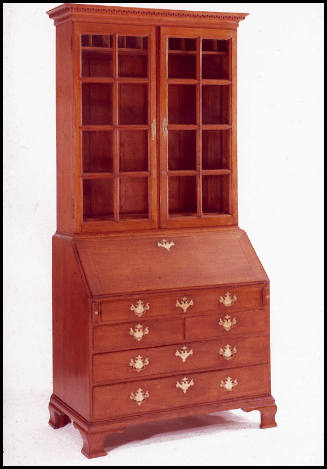
1760-1780
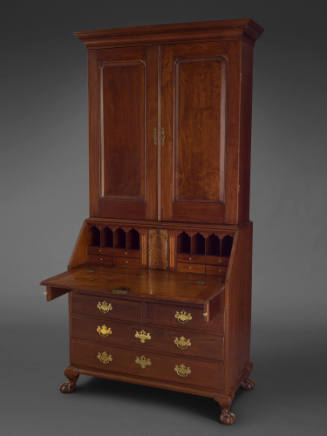
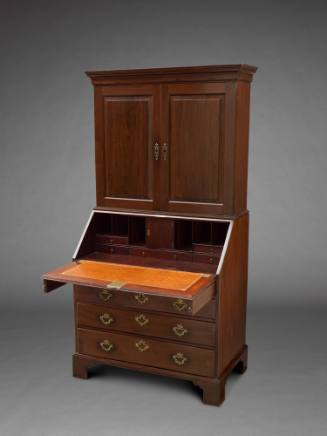
1760-1775
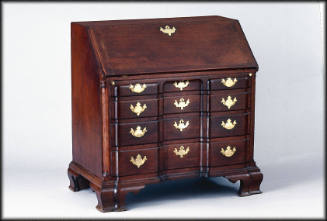
1770-1780
1780-1795
1790-1805
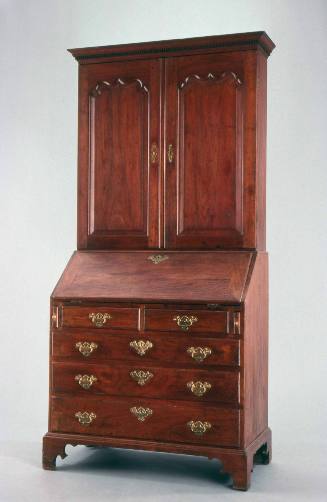
1770-1800