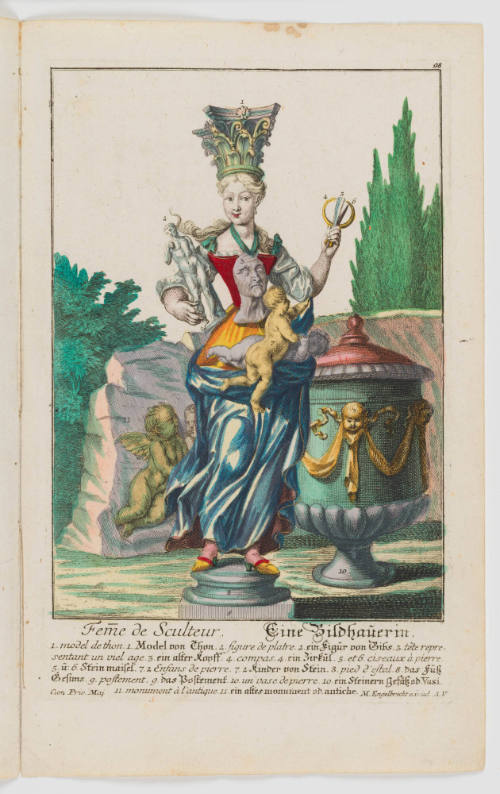
Femme de Sculteur (female sculptor)
Dateca. 1720
Engraver
Martin Engelbrecht
OriginEurope, Germany
MediumLine engraving and etching on laid paper with hand coloring
DimensionsOverall: 14 × 8 1/2 in (35.56 × 21.59cm)
Platemark: 12 × 7 3/4 in (30.48 × 19.68cm)
Platemark: 12 × 7 3/4 in (30.48 × 19.68cm)
Credit LineMuseum Purchase
Object number1955-150,22B
DescriptionUpper right corner reads, "98"Lower margin reads, "Feme de Sculteur. Eine Bildhaũerin./ 1. model de thon 1. Model von Thon. 2. figure de platre 2. ein Figũr von Gibs. 3. tete repre/ sentant un viel age. 3. ein alter Kopff. 4. compas 4. ein Zirkũl. 5. et 6. ciseaux a pierre/ 5. ũ: 6. Stein maisel. 7. 2 Enfans de pierre 7. 2 Kinder von Stein. 8. pied d'estal. 8. Das Fũk/ Gesims. 9. postement 9. das Bostement. 10. un vase de pierre 10. ein Steinern Gefak od Vasi./ Cum Priv. Maj. 11. monument a l'antique 11. ein altes monument od. atiche. M. Engelbrecht excud. A.V."Label TextMartin Engelbrecht’s mid-18th century publication on trades included both a male and female illustration of each trade or profession in creative ways. Though they represent the tools that tradesmen used and the products they produced, they were meant to entertain elite audiences rather than inform about the labor involved in these trades or professions.This print represents an idealized version of a female sculptor. She carries the tools and products of her trade on her person as follows: 1. (on head) model de thon ( ornamental model); 2. (right hand) figure de platre (plaster figure); 3. (around neck) tete representant un viel age (head representing an old man); 4. (inleft hand) compas (compass); 5. (left hand) et ciseaux a pierre (piercing scissors); 6. (at waist) 2 Enfans de pierre (2 infants in stone); 8. (at foot) pied d'estal (foot of pedestal); 9. (just below) postement (base); 10. (rear of figure) un vase de pierre (vase of stone); 11. (rear of figure) monument a l'antique (antique monument).
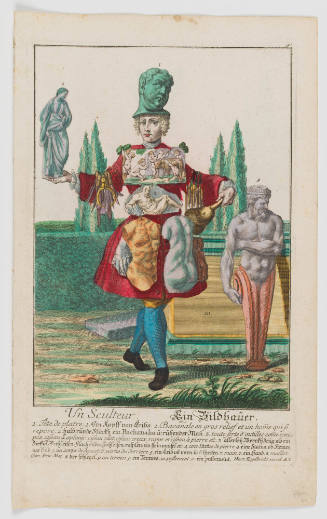
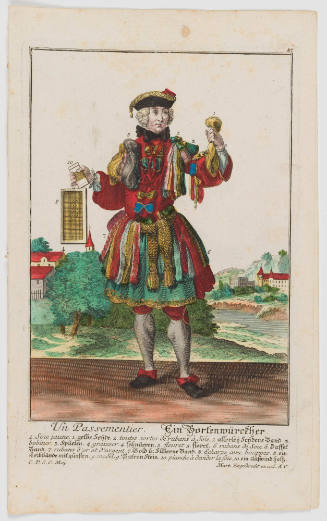
This print is from a series of 189 engravings consisting prints featuring depictions of tradesmen in the format known as composite figures, which are human figures made up of objects. Sometimes various accoutrements or tools are cleverly incorporated into recognizable garments or even replace body parts. Each plate represents different trades by trades men and women dressed with associated tools and products. They do not represent actual tradespeople nor are they meant to suggest that women participated in these trades, though in some cases they may have.They were designed by Johann Jacob Stelzner (1706-1780), C.F. Horstman and M. Rosler. They were etched by Martin Engelbrecht ( 1684–1756). The series was published in a compilation known as, From Martin Engelbrecht, "L' Assemblage nouveau des manouvries habilles or Neu-eröffnete Sammlung der mit ihren eigenen Arbeiten und Werkzeugen eingekleideten Künstlern, Handwerkern und Professionen," (Augsburg, Germany, ca. 1730).Mark(s)Cum Priv. Maj. Plate #98ProvenanceBefore 1955, the Old Print Shop (New York, NY); 1955-present, purchased by the Colonial Williamsburg Foundation (Williamsburg, VA).

Clemendt de Longhe
1660-1685



1760-1780