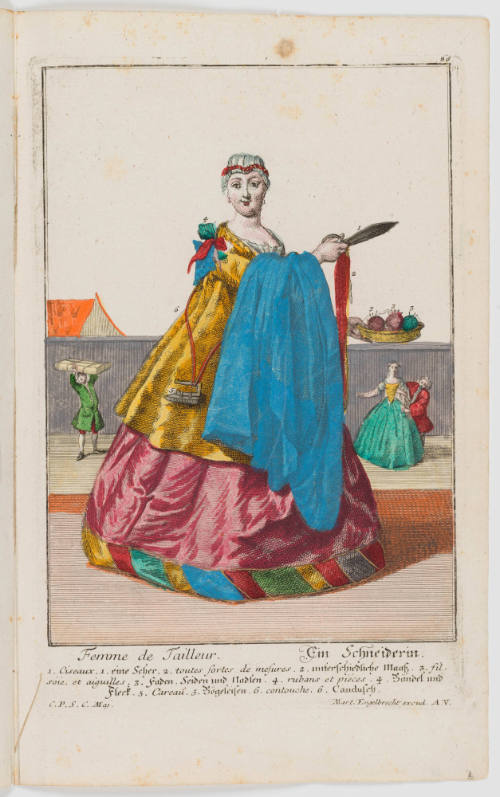
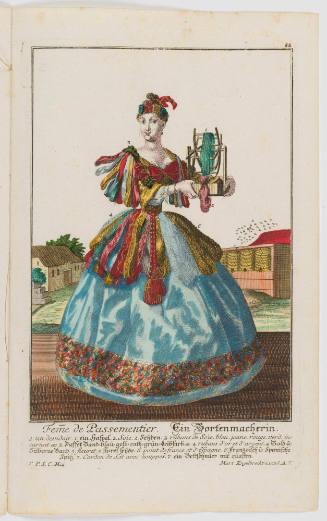
Femme de Tailleur (female tailor)
Dateca. 1720
Artist/Maker
Martin Engelbrecht
OriginEurope, Germany
MediumLine engraving and etching on laid paper with hand coloring
DimensionsOverall: 14 × 8 1/2 in (35.56 × 21.59cm)
Platemark: 12 × 7 3/4 in (30.48 × 19.68cm)
Platemark: 12 × 7 3/4 in (30.48 × 19.68cm)
Credit LineMuseum Purchase
Object number1955-150,20B
DescriptionUpper right corner reads: "86"Lower margin reads, "Femme de Tailleur. Ein Scheiderin./ 1. Ciseaux 1. eine Scher. 2. toutes sortes de mesures 2. unterschiedliche Maaf 3. fil/ soie, et aiguilles 3. Faden, Seiden und Nadsen. 4. rubans et pieces 4. Zandel und/ Flerk. 5. careau 5. Zőgeleisen. 6. contouche 6. Candusch./ C.P.S.C. Maj. Mart. Engelbrecht excud. A.V."Label TextMartin Engelbrecht’s mid-18th century publication on trades included both a male and female illustration of each trade or profession in creative ways. Though they represent the tools that tradesmen used and the products they produced, they were meant to entertain elite audiences rather than inform about the labor involved in these trades or professions.This print represents an idealized version of a female tailor. She carries the tools of her trade on her person as follows (titles in old German also): 1. (right hand) Ciseaux (scissors); 2. (right hand) toutes sortes de mesures (tape measure); 3. (left hand) fil soie, et aiguilles (thread silk & needles); 4. (right shoulder) rubans et pieces (ribbons and patches); 5. (hanging from shoulder) careau (iron); 6. (around her shoulders) contouche (lose cape).
This print is from a series of 189 engravings consisting prints featuring depictions of tradesmen in the format known as composite figures, which are human figures made up of objects. Sometimes various accoutrements or tools are cleverly incorporated into recognizable garments or even replace body parts. Each plate represents different trades by trades men and women dressed with associated tools and products. They do not represent actual tradespeople nor are they meant to suggest that women participated in these trades, though in some cases they may have.They were designed by Johann Jacob Stelzner (1706-1780), C.F. Horstman and M. Rosler. They were etched by Martin Engelbrecht ( 1684–1756). The series was published in a compilation known as, From Martin Engelbrecht, "L' Assemblage nouveau des manouvries habilles or Neu-eröffnete Sammlung der mit ihren eigenen Arbeiten und Werkzeugen eingekleideten Künstlern, Handwerkern und Professionen," (Augsburg, Germany, ca. 1730).Mark(s)C.P.S.C.Maj. Plate #86ProvenanceBefore 1955, the Old Print Shop (New York, NY); 1955-present, purchased by the Colonial Williamsburg Foundation (Williamsburg, VA).



Clemendt de Longhe
1660-1685