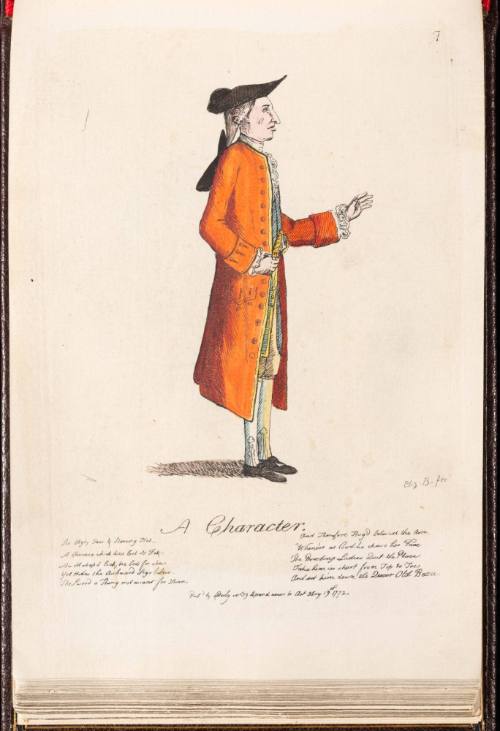
A Character
Date1772
Engraver
Elizabeth Bridgetta Gulston
1749 - 1779
Publisher
M. Darly
Publisher
Mary Darly
1760 - 1781
Publisher
Matthew Darly
ca. 1720 - 1780
OriginEngland, London
MediumEtching and line engraving on laid paper with hand coloring
DimensionsOverall: 8 5/8 × 5 9/16in. (21.9 × 14.1cm)
Other (Plate): 7 × 5in. (17.8 × 12.7cm)
Other (Plate): 7 × 5in. (17.8 × 12.7cm)
Credit LineMuseum Purchase
Object number1955-62,58
DescriptionUpper right corner reads: "7"Lower margin reads: "Eliz. B. fec/ A Chracter./ An Ugly Face & Staring Hat/ A Carcase which has lost its Fat./ an ill shap'd Coat, too bad for shew/ Yet Hides the Awkward Legs below/ The Sword a Things not meant for Harm/ And Therefore Hug'd betwixt the Arm./ Whene'er at Court he shews his face/ The Breeding Ladies Quit the Place/ Take him in short from Top to Toe/ And set him down the Queer Old Beau./ Pub.d by Darly at 39 Strand accor to Act May 19.th 1772."Label TextThe print is plate 7 from volume III of six volumes of Mary and Matthew Darly's "24 Caricatures by Several Ladies Gentleman Artists &c." This caricature was etched by Elizabath Bridgetta Gulston, who was an amateur astronomer, poet, and etcher. She as the daughter of Sir Thomas Stepney and married to Joseph Gulston. The plate depicts a man (possibly Samuel Drybutter) standing in profile facing right, apparently caricatured for his old fashioned dress and straight lank figure. His left hand is outstretched, his right holds a sword of which only the hilt is visible. He wears a wide flat hat and bag wig. His long orange coat and blue waistcoat hang well below his knees.
Beneath the title is etched:
An Ugly Face & Staring Hat
A carcase which has lost its Fat
an ill shap'd Coat, too bad for shew
Yet Hides the Awkward Legs below
The Sword a Thins not meant for Harm
And therefore Hug'd betwixt the Arm.
Whene'er at Court he shews his face
The Breeding Ladies Quit the Place
Take him in short from Top to Toe
And set him down the Queer Old Beau.
According to the British Museum, Ambrose Heal identified the figure in this print as Samuel Drybutter, who is the subject of 1955-62,16, though that is the only attribution that could be located. Drybutter was a Westminster bookseller and jeweler who was charged and publicly punished for homosexual acts in the 1770s in London. (1)
The Darly's were a husband-and-wife team capitalized on the craze for caricatures, the practice of making a likeness with exaggerated mannerisms or features to create a comic effect, a form that was brought back by aristocratic Britons who visited Italy on the Grand Tour. The Darly’s catered to this audience by publishing a prolific assortment of caricature prints during the 1770s. Many of the Darly's satirized the manners and fashions of the macaroni, a term used to describe a sub-culture of fashionably dressed men during the period, and subsequently, regardless of subject, the Darly's prints were known as "macaroni prints."
Their most famous work was their encyclopedic "Caricatures" which included prints of macaroni’s as well as other interesting characters, such as macaronis, all based on their own drawings and those submitted to them by amateur artists lambasting their friends, artists, and other figures in London life. The front page of Volume I describes them as “…a Series of Drol[l] Prints consisting of Heads, Figures, Conversations and Satires upon the follies of the Age…” These prints were published in groups of 24, in six volumes that were published between 1771 and 1773. Colonial Williamsburg owns volumes 1-4.
1) For more on Samuel Drybutter, see: Rictor Norton, "The Macaroni Club: Homosexual Scandals in 1772", Homosexuality in Eighteenth-Century England: A Sourcebook, 19 December 2004, updated 11 June 2005, updated 13 June 2017
1784 (dated)