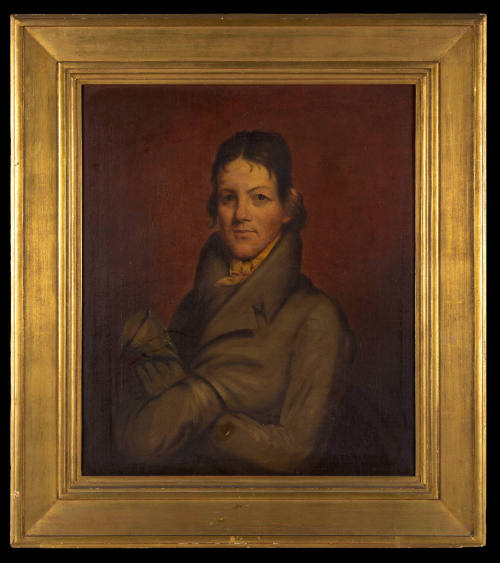
Portrait of John Randolph of Roanoke
Date1827
Attributed to
Samuel Lovett Waldo
1783 - 1861
MediumOil on canvas
Credit LineGift of Margaret Almeida
Object number2026-12,A&B
DescriptionPortrait of a man in a grey coat. His arms are crossed in front of his body and his proper right hand is tucked into the goat. His left hand holds the glove for the right. He has dark brown hair that falls in front of his ears and a yellow kerchief tied around his neck. He is depicted in front of a red brown background.Label TextJohn Randolph was born near Hopewell, Virginia, in 1773 to John Randolph and his wife, Frances Bland. After his father died, his mother married St. George Tucker of Williamsburg. Randolph grew up to become a prominent politician during the Federal Period serving in the House of Representative from 1799 until his death in 1833. He took a short break from 1825-1827 to serve in the Senate and a one-year stint as the Minister to Russia in 1830. He was the chief prosecutor when Samuel Chase of Maryland was impeached from his role on the Supreme Court in 1804. Randolph was the leader of the “Old Republicans” a wing of the Democratic-Republican Party which wanted to restrict the role of the federal government. Randolph held mixed views on slavery during his lifetime – while he opposed the Missouri Compromise of 1820 because he did not believe in the expansion of slavery, he believed that slavery was a necessity to Virginia’s economy and personally enslaved hundreds of people who worked his tobacco plantation in Charlotte County. In his will, however, he provided for the manumission of all his enslaved workers, settling them in the free territory of Ohio with each person above the age of 40 to receive 10 acres of land. The will was contested in court but in 1846, 383 of the individuals arrived in Cincinnati where Randolph’s executor had purchased 3200 acres of land. Again, there was some push back and many ended up leaving the Cincinnati area and settling in nearby Miami and Sleby Counties.
John Randolph of Roanoke sat for multiple portraits by several artists. Spme of those works were then copied for friends and colleagues in Congress. This portrait appears to be an 1827 copy by Sameul Lovett Waldo made after an 1817 copy, by John Wesley Jarvis of his orginial 1811 portrait.Inscription(s)Two paper labels on back. The more legible one, which is typed, reads –
“This picture came to Dr. John Randolph Graham from his Mother, Fanny Bland Graham, who had inherited it from her Mother, Anne E.T. Magill. I believe that the latter had inherited it from her Father, Judge Henry St. George Tucker, a younger half brother of John Randolph of Roanoke.
The following note, almost illegible was on the back of the painted when it was freshened up in 1936.
‘Honorable Jno. Randolph of Roanoke. Copy of a picture painted about 1816-1817. Supposedly by Waldo. Copied 1827’.
Who made this note is not stated.
This memorandum is typed in July 1936 by Dr. John Randolph Graham, a great grand Nephew and namesake of John Randolph of Roanoke.”
A smaller, handwritten label, which is referenced by the other reads - "Honorable Jno. Randolph of Roanoke. Copy of a picture painted about 1816-1817. Supposedly by Waldo. Copied 1827"ProvenanceAccording to family history, the portrait was commissioned by the sitter's half-brother, Henry St. George Tucker [1780-1848] (Winchester, VA); by 1855, to his daughter, Ann Evelina Hunter Tucker Magill [1809-1875] (Staunton, VA); by 1875, to her daughter, Frances Bland Tucker Magill Graham [1828-1901] (Winchester, VA); by 1914, to her son, Dr. John Randolph Graham [1874-1966] (Winchester, VA); by 1966, to his great-nephew, Rev. Dr. John Randolph Taylor [1929-2002] (Montreat, NC); by 2021, to his daughter who was Colonial Williamsburg's donor.
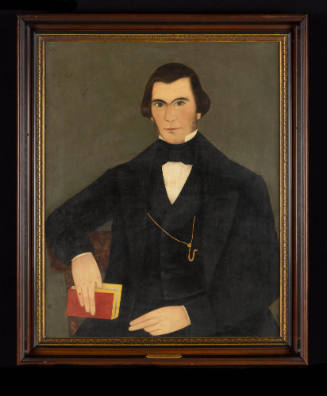
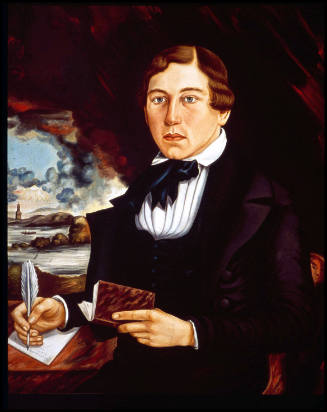
ca. 1845
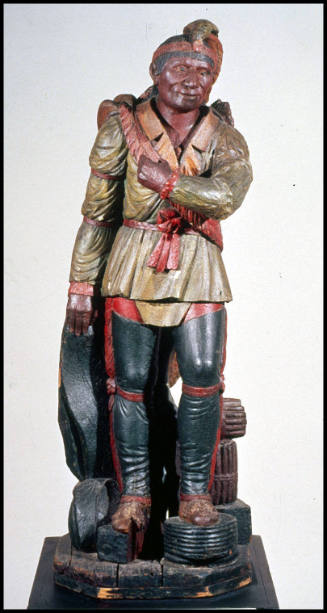
ca. 1850
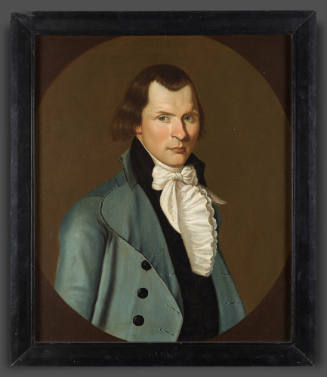
Probably 1788
ca. 1845-1850