
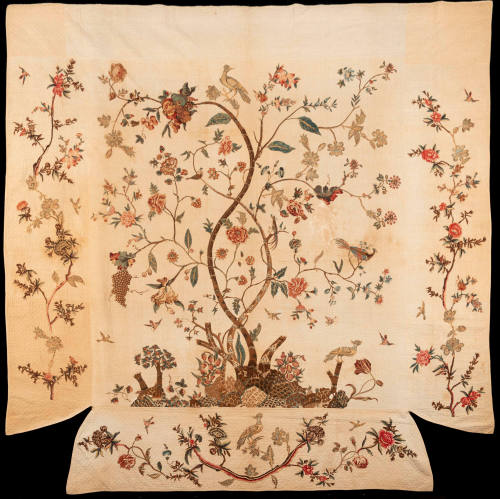
Quilt, Appliqued Flowering Tree
Date1790-1810
OriginAmerica (probably)
MediumCottons
DimensionsWidth 97 in.
Height 95 in.
Height 95 in.
Credit LineGift from The Valentine Museum, Richmond, VA
Object number2025-81
DescriptionQuilt with large central flowering tree appliqued from multicolor printed cottons on white ground, sometimes known as a "Tree of Life" pattern. Twining brown and green branches grow from a hilly base pieced from various multicolor printed cottons consisting of abstract patterns, small fruit trees, and strawberries. The large twining branches sprout flowers in red and pink, with pencil blue accents, green leaves, pomegranates, a grape cluster, and exotic perching and flying birds. The central tree is bordered on the sides and bottom by 16 1/2-inch-wide drops featuring additional appliqued vines with flowers and birds. The bottom corners are cut on a diagonal to allow the drops to fit over the bed posts. The bed cover is quilted in an overall diagonal grid, 12 running stitches per inch, through very thin batting and white cotton backing. Side and bottom edges are bound with cotton twill tape; the top is bound with straight-grain cotton binding.Label TextWhile little is known about the maker or makers of this quilt, the style is familiar to CWF's collection. It is an example of chintz applique, a technique popular in the late 18th and early 19th centuries. Makers frequently repurposed printed textiles intended for home furnishing, cutting out flowers, vines, birds, and more and stitching them onto their quilt tops. The popularity of this style- and of quilting more generally- was soon recognized by textile manufacturers, who began producing printed cottons specifically for the quilting market.Inscription(s)"De Priest" inked on back side of twill binding.ProvenanceDates unknown, history unknown; dates unknown to 1970, Ella Williams Bueck Smith [1888-1974] (Richmond, VA); 1970, gift to Valentine Museum (Richmond, VA); 2025, gift to Colonial Williamsburg Foundation (Williamsburg, VA).
1840-1880

ca. 1800

1700-1725

1862 (dated)



1775-1785

ca. 1835 using some earlier textiles

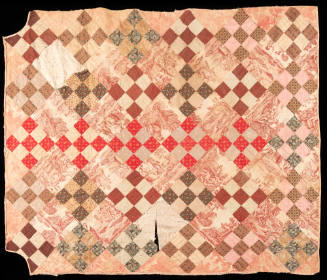
ca. 1850, using some older textiles