

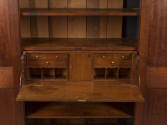


Armoire and Secretary
Date1790-1810
MediumBlack walnut, cherry, possibly holly (inlay), white pine, spruce, ash, tulip poplar, and brass
DimensionsOverall: 87 × 55 1/8 × 21in. (221 × 140 × 53.3cm)
Credit LineGift of H. Parrott "Pat" Bacot and Barbara SoRelle Bacot in honor of Ronald L. Hurst
Object number2025-124
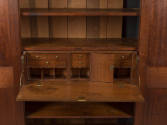
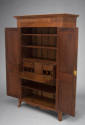
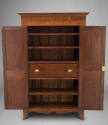
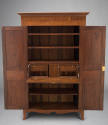
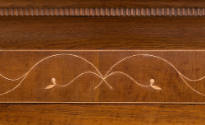
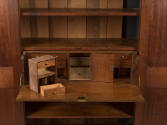
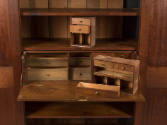
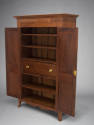
DescriptionArmoire with coved and stepped dentiled cornice over a cherry frieze with an inlaid lightwood serpentine vine over two full height recessed flat paneled doors, serpentine skirt and slightly splayed French feet; doors consist of one long panel over a shorter panel divided by a wide medial rail, and thinner stiles and upper and lower rails, inlaid lightwood diamond keyhole escutcheons on both doors with lock on proper left door; front stiles outlined in light wood stringing with arched base and pointed top; plain quarter columns at front corners; inlaid light and dark wood banding around base; doors butt hinged to stiles open to reveal five shelves with scratch beaded edges and one deep secretary drawer in center; secretary drawer has two oval pressed brass drawer pulls and one central light wood inlaid diamond keyhole escutcheon.Interior of secretary drawer has a central prospect cabinet with hinged door flanked by removable compartments on either side; removable compartments consist of two short drawers over one long drawer, each with a single brass knob, over three valanced pigeon holes with shaped dividers; compartments can be removed to reveal three tulip poplar graduated drawers with wooden knobs behind; prospect cabinet contains a removable compartment consisting of two drawers over two valanced pigeon holes with a shaped divider; prospect cabinet compartment removes to reveal three graduated tulip poplar drawers with round knob pulls; forward compartments lock into place with walnut tabs that slide into the secretary sides and prospect cabinet sides; walnut tabs set into the top of the dust board with round disks projecting below that are accessed from the pigeon holes.
Woods: black walnut primary with cherry frieze in cornice with lightwood, possibly holly inlay; tulip poplar backboards and hidden drawer fronts; white pine shelves and drawer parts; spruce drawer parts; ash top board of secretary drawer and runners around drawer.
Drawer construction: drawers in the front portion of the secretary with walnut drawer fronts have standard dovetail construction with drawer bottoms set into rabbets in the front and sides and nailed to the front rabbet and bottom edge of drawer back. Hidden drawers with tulip poplar drawer fronts have standard dovetail construction with chamfered drawer bottoms in dados in the drawer front and sides and are pegged with wooden pegs to the bottom edge of the drawer backs. Dovetail size and spacing is consistent between these two drawer construction types.
Armoire shelves are fixed in dados and half dovetails in case sides. Backboards are tongue and groove, nailed to the edge of the top, bottom, and in rabbets in the case sides.Label TextLike the furniture of Louisiana, high style furniture made and used in elite Mississippi homes along the river combined influences of French and Anglo-American styles and decoration. This armoire, which descended from John Wall of Fort Adams, Mississippi, follows the French fashion for stately, tall clothing and linen shelved storage units with the more typically British or American variation of “French” feet and a serpentine vine inlay. The interior also contains a secretary drawer, a feature not found in Louisiana armories, but likely specifically bespoke for this piece (although possibly at a slighter later date). Also, unlike the Louisiana armoires, this example does not have fiche hinges but rather has more standard butt hinges joining the doors to the case. Two or three other armoires from this shop group with Mississippi histories survive including one in the Louisiana State University Museum in Baton Rouge. Each of these armoires has a different central element on the central shelf (drawers and secretary drawer).ProvenanceBelieved to have descended from John Wall (1752-1813) & Sara Lovelace Wall (1776-1833); to son Henry Hughson Wall (1811-1892) & Mary Ellen Evans Wall (1830-1891); to son Evans Spencer Wall (1856-1939) and Mary Letterman Pettibone Wall to son Henry Hughson Wall Sr. and Nora Elizabeth Shwing Wall; to son Henry Hughson Wall, Jr and Frances Louise Verdella Wall; to son Michael Verdellla Wall and Pemela Ruth Davidson Wall. Or, another possible line of descent: John Wall (1752-1813) & Sara Lovelace Wall (1776-1833) to son Alexander Edward Wall (1806-1866) and Charlotte Jane Davis Wall (1823-1845); to son Dr. William Davis Wall (1843-1929) and Annie Whitaker Wall (1845-1939) to son Dr. William Davis Wall II (1870-1937) and Ludie Irma Patout Wall (1872-1953); to son Rivers Patout Wall and Margaret Gasell Weeks Wall; to son Rivers Patout Wall Jr. and Frances Dickens Hendrix Wall.
Donors purchased the armoire from David Pruett of Natchez, Mississippi around 1968.
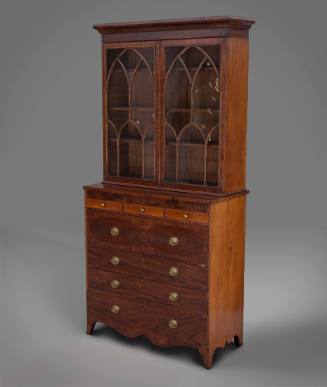
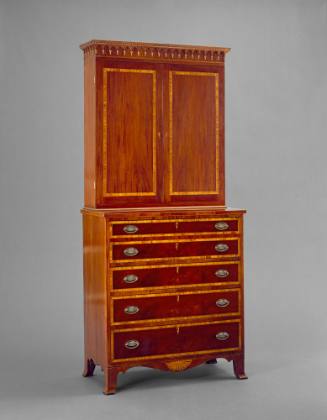
1800-1815
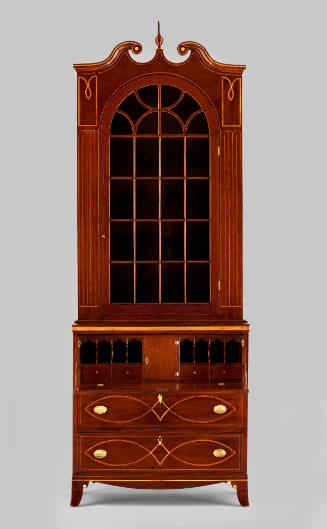
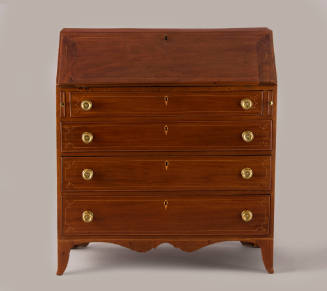
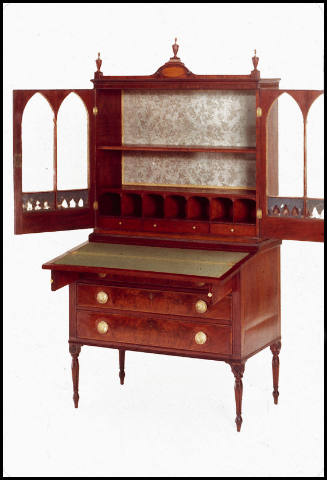
1790-1815
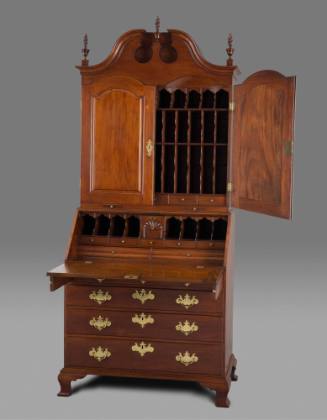
1760-1780
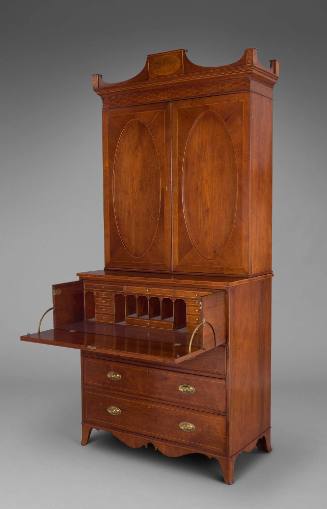
ca. 1800
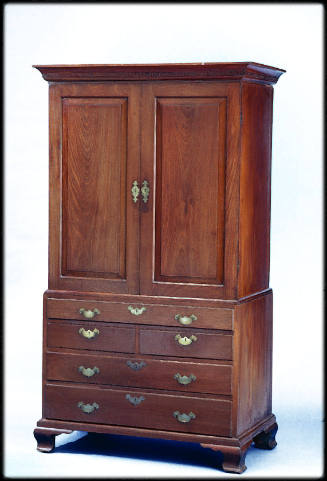
1760-1780
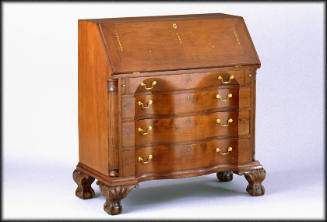
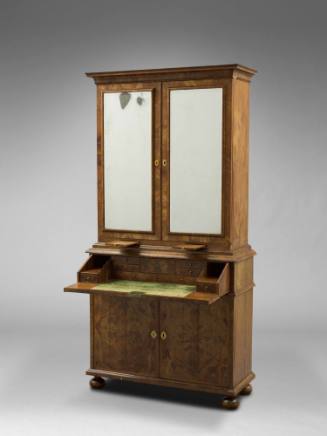
1705-1715
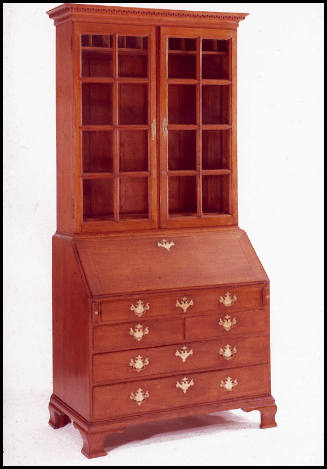
1760-1780
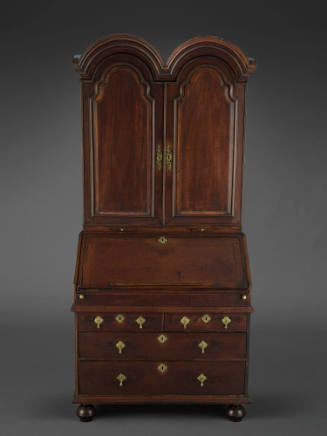
1700-1730