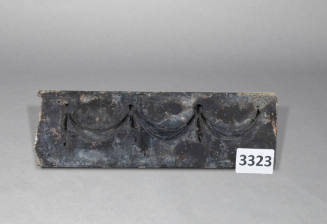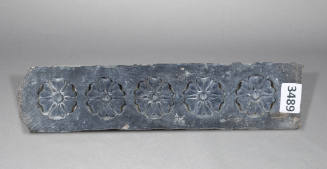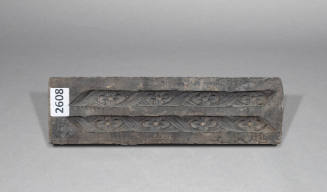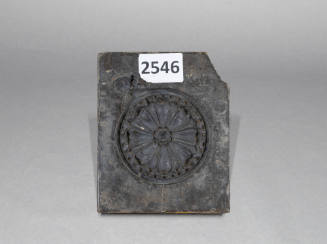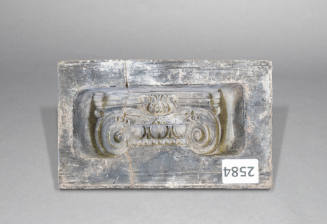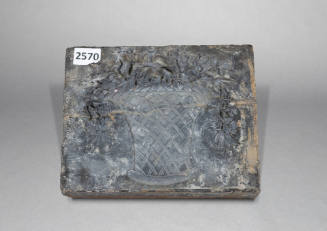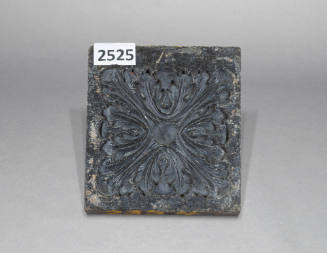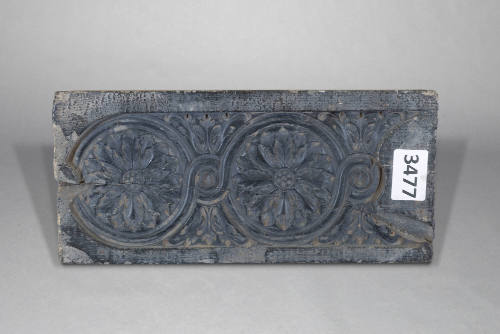
Composition Mould
OriginEngland or America
MediumCementitious material; Wood
DimensionsImpression: 10 3/8" (L) x 4" (W) x 1/4" (T). Base: 11 3/4" (L) x 5 1/8" (W) x 1 1/2" (T).
Credit LineGift of Mr. & Mrs. Elias Nassim
Object numberAF-X2023.3477
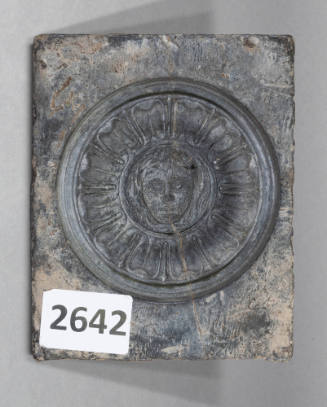
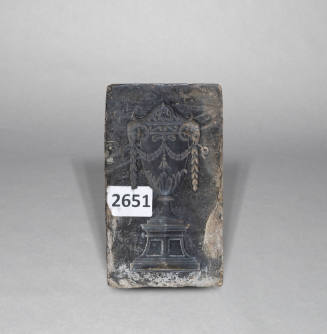
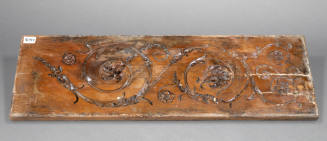
DescriptionIt is a guilloche of concentric circles enclosing two floral rosettes. It is set in a cementitious matrix with a section of wood plank flooring set into the rear face of the matrix as reinforcement. There is a crack on both ends matching cracks on the rear face. The guilloche is made up of two intertwined ropes with a small center oval bead in between and on one end. The central oval bead is separated by acanthus leaves on each side of the rope knot. The oval bead is surrounded by the entwined knot. The rosettes have 16 petals with a central pistil consisting of seven stigmas (beads).Label TextThis antique composition mould represents a trade that was practiced in Virginia during the Revolutionary period and into the 19th century. It depicts a common design found in upper class homes and public buildings. Composition was a substitute for more laboriously produced ornamental plaster and carved wood and stone. It is thought that the Adam brothers (Robert Adam 1728-1792) and John Adam (1721-1792)) played a major role in the initial manufacture of composition ornament on a grand scale. The Adam style demanded a large amount of delicate low-relief ornament. These moulds are for the production of such ornament in plaster, or in composition, usually a combination of whiting, glue, rosin and oil. The finished ornament was used on furniture and other objects as well as in the decoration of rooms.