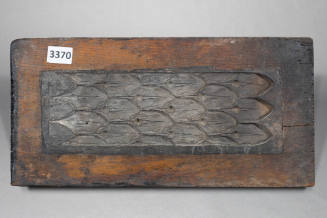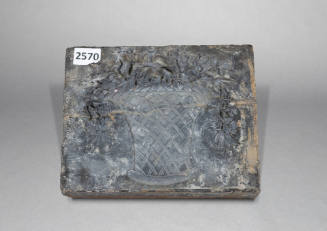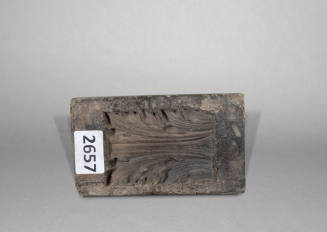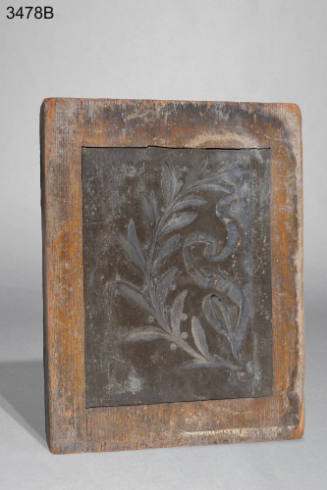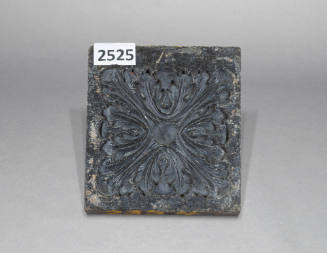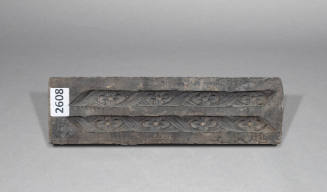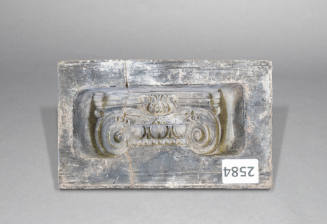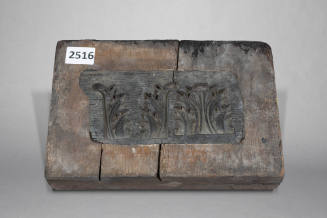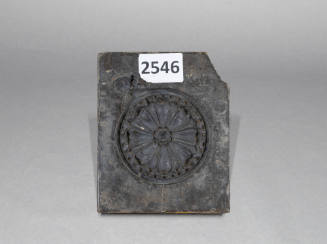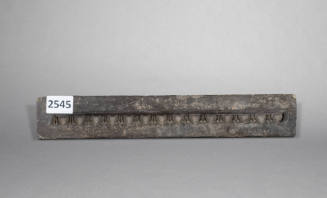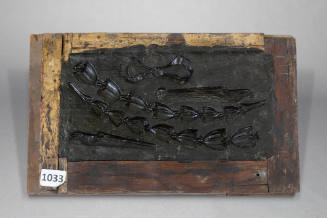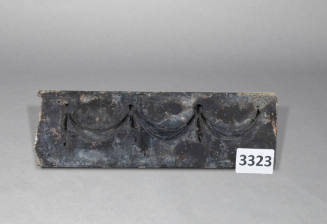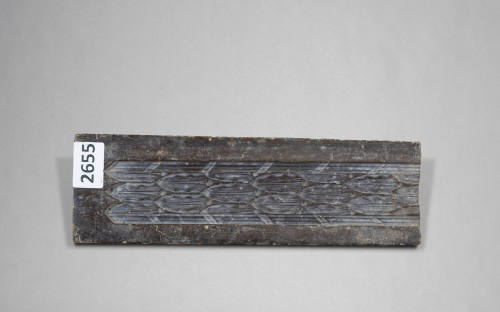
Composition Mould
OriginEngland or America
MediumCementitious material
DimensionsThe impression is 10 3/8" (L) from leaf tip to bottom of stem and 2" (W) x 1/4" (D). The berries are 3/16" in diameter and 1/8" deep. The leaf dimensions are 2 7/16' (L) from tip to end of stem x 5/8" (W) x 1/8" (D). Base: 11 1/2" (L) x 3 9/16" (W) x 1 3/16" (T). The outer edges of the impression are the deepest.
Credit LineGift of Mr. & Mrs. Elias Nassim
Object numberAF-X2023.2655
DescriptionIt is a cementitious mold with a leaf and berry repeat (six rows and 2 columns and two edge half columns). There are 9 complete leaf and berry impressions. The berry is centered at the top of the stem and the stem continues through the length of the leaf. At the tips of the double leaves there are single outer berries on each side that extend on a diagonal away to the outer edge of the impression on each side.Label TextThis antique composition mould represents a trade that was practiced in Virginia during the Revolutionary period and into the 19th century. It depicts a common design found in upper class homes and public buildings. Composition was a substitute for more laboriously produced ornamental plaster and carved wood and stone. It is thought that the Adam brothers (Robert Adam 1728-1792) and John Adam (1721-1792)) played a major role in the initial manufacture of composition ornament on a grand scale. The Adam style demanded a large amount of delicate low-relief ornament. These moulds are for the production of such ornament in plaster, or in composition, usually a combination of whiting, glue, rosin and oil. The finished ornament was used on furniture and other objects as well as in the decoration of rooms.