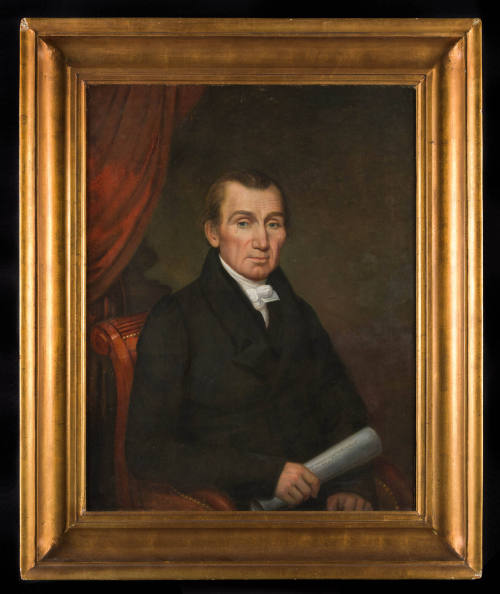
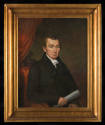
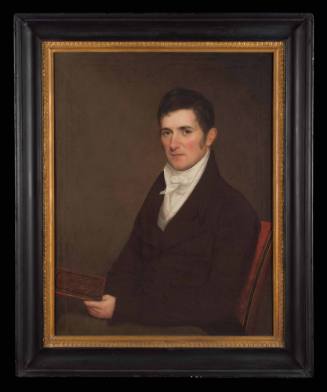
Portrait of James Monroe
DateDecember 1830
Artist
John Wesley Paradise
1809 - 1862
MediumOIl on canvas
DimensionsFramed: 35 3/4 × 27 3/4in.
Credit LineMuseum Purchase, Robert and Carol Clayman Woody and Robert and Elizabeth Mustain
Object number2025-6,A&B
DescriptionPortrait of a man wearing a black jacket and waistcoat with white shirt and stock. He his seated in an arm chair with his proper right elbow resting on the arm of the chair. In that had he holds a scroll inscribed “Mr. Monroes addings to the nationa/ convention of France in 1794”Label TextThis portrait of James Monroe was completed in 1831, just months before his death on July 4th. It was commissioned by his friend, Silas Burrows, a merchant who at times traveled the world on official government business. The first instance of this came in 1818, at the age of 18, when Burrows was chosen by the then President Monroe to carry a treaty to Stockholm. He was recommended to Monroe by Connecticut governor Oliver Wolcott, Jr. In his plea to Monroe, Wolcott writes, "Mr. B. [Silas Burrows] is the son of the Honorable Enoch Burrows of this State, who has invariably devoted his resources and influence to aid the present and last administration of this country. Mr. Burrows was one of the gallant defenders of Stonington, when that place was attacked by the British fleet during the last war; and this fact will, I am sure, introduce him advantageously to the President of the United States."Just 10 years later, Burrows returned the favor and offered Monroe $1200 to cover the annual interest in Monroe's home in an effort to prevent its sale to pay off debts incurred after his presidency. In 1826, he moved from his primary residence at Highland in Albemarle County to Oak Hill (Loudon County), selling the home and core 907 acres. In 1828, the remaining 2800 acres of Highland were offered by sale by the Bank of the US.
Burrows was vocal in advocating that Jackson and Congress assist Monroe in paying off his debts. After a trip to Washington in 1831, Burrows stopped in Philadelphia to meet with Nicholas Biddle, president of the US Bank. During that meeting, he promised Biddle that he would persuade Monroe to write a letter to Congress defending the usefulness of the national bank (which was under fire by opponents).
A letter dated March 15, 1831, from Monroe to Burrows documents the portrait: "My portrait for you is at last finished, and knowing as you do, my exhausted state and great debility, I am sure, you will believe, that you are one of the few friends, for whom I could have exerted myself, to set for is completion. I am so reduced, that with all the artist's skill, I am fearful, it will not give you pleasure, as a remembrance of me, the countenance being so unlike mine, as you have known it in former days. I have nothing, dear Mr. Burrows, to leave you with it, as last remembrance, that I think you would desire, except you may be pleased with some of my old commissions, if so, all of which are at your disposal. That from President Washington to the Old French Republic, in 1795, and from President Jefferson in 1803, to Spain, as Minister from the United States, may give you and your children intereste, as a record of that name, who has received from you the kindness of a son to a parent, and who remains your most sincere friend, James Monroe." (New York, March 15, 1831)
The portrait, painted by John Wesley Paradise in New York, was given by Burrows to Virginia Supreme Court Justice Robert Stannard, a mutual friend of Monroe’s, around the time of Burrows’s death in 1870 and it descended through the Stannard family of Richmond until the 21st century.
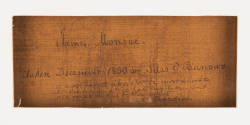
Inscription(s)Inscribed on reverse - "James Monroe. / Taken December 1830 for Silas E Burrows. / a most perfect likeness to the most accurate / Mr Monroe said that had been taken and / did great merit to the artist / Mr Paradise"Provenance1830, commissioned by Silas E. Burrows [1794-1870] (New York, New York); ca, 1870, Judge Robert Craig Standard [1814-1857] and Mrs. Martha (Pearce) Stanard [1820-1894] (Richmond, Virginia); By 1894, to the previous owners who were the consignors at auction; 2025, sold by Christie’s Auction [January 24, 2025, lot 624] (New York, New York); 2025, purchased by The Colonial Williamsburg Foundation (Williamsburg, VA).
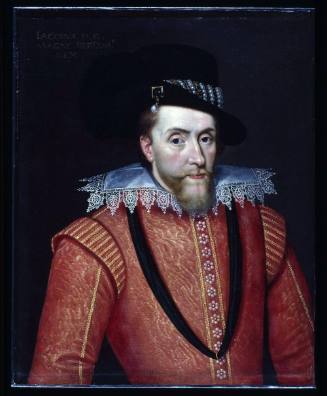
John de Critz the Elder
Possibly 1606-1615
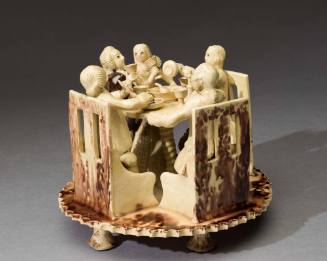
ca. 1745
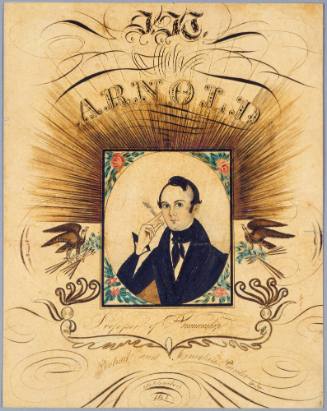
Francis Martin Drexel
ca. 1820