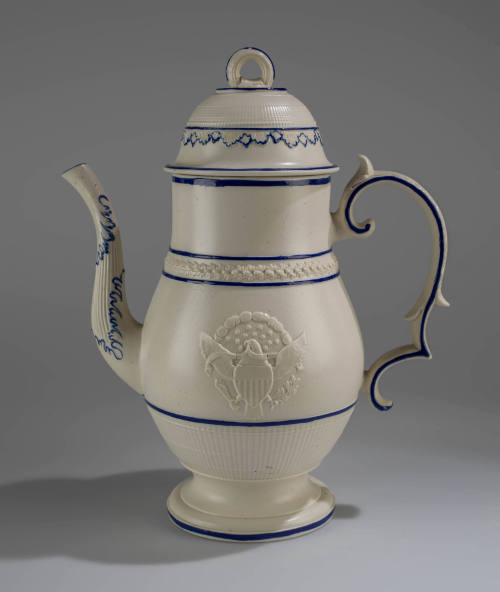
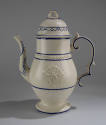
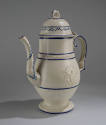
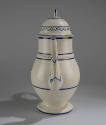
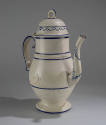
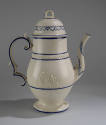
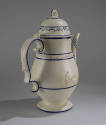
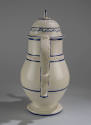
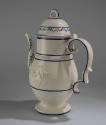
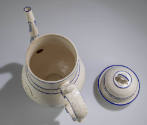
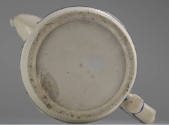

Coffeepot
Dateca. 1800
Maker
Chetham & Woolley
1793-1871
MediumFeldspathic stoneware
DimensionsOH: 12 5/8" (with lid); OL: 10 5/8" (handle to spout); OW: 6 1/4" (body at widest point).
Credit LineMuseum Purchase, The Friends of Colonial Williamsburg Collections Fund
Object number2024-252,A&B
DescriptionCoffeepot: circular stepped and spreading foot supports the large baluster-shaped body, the lower third molded with basket pattern and the top third delineated by a band of oak leaves; the body bearing the Great Seal on one side and figures of Plenty and Commerce on the other. The angular double-C scroll handle molded with acanthus leaves and with an acanthus leaf thumb rest and kick; the handle opposite the modified S-shaped spout molded with a leaves and a basket weave. An open hole without a grate is at the spout and body juncture. The pot with a high-domed lid molded with a border of leaves and a basketweave pattern radiating from the upright ring knop with molded strap juncture; a steam hole on the top of the lid next to the finial. The body, lid, foot, handle and spout carefully picked out in a deep blue.Label TextThis monumental coffeepot bears the Great Seal of the United States, clearly proclaiming the vessel’s intended market. The Great Seal medallion draws its design source from contemporary numismatic productions. It closely copies the “Heraldic Eagle” that appears on the $1 coins struck in Philadelphia beginning in 1798 (see accession 2015-352 for an example of such a coin). The medallion on the opposite side of the pot depicts figures of Plenty and Commerce, popular imagery seen in British prints and on American currency of the period. Molds for similar Peace and Commerce medallions survive in the Leeds Museum collection with Leeds Pottery histories. (See John D. Griffin’s publication The Leeds Pottery, 1770-1881, Vol. I.) But other aspects of this coffeepot including the oak-leaf band, distinctive double c-scroll handle with spurs enable this handsome pot to be attributed to the Chetham and Woolley pottery in Staffordshire. Perfected by British potters, feldspathic stoneware served as the ideal melding of properties of porcelain and stoneware into one material. The high feldspar content made the ware nearly translucent like porcelain, but its stoneware properties enabled it to be crisply molded. Fragments of feldspathic stoneware turn up throughout late 18th and early 19th century America.Inscription(s)NoneMark(s)NoneProvenance2024, [David M. Kurau (Royersford, PA) Nov. 14-17, 2024, exhibited at the Delaware Antiques Show, Wilmington, DE]; December 2024, purchased by The Colonial Williamsburg Foundation (Williamsburg, VA)
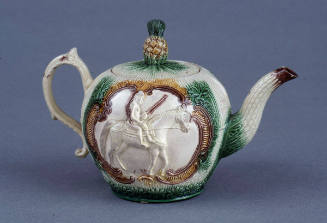
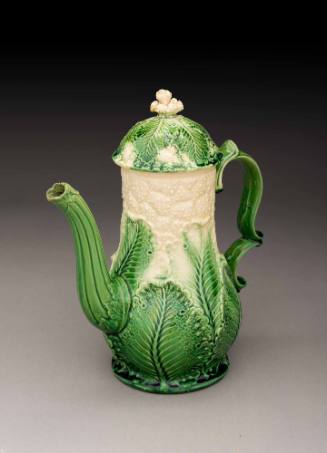
ca. 1765
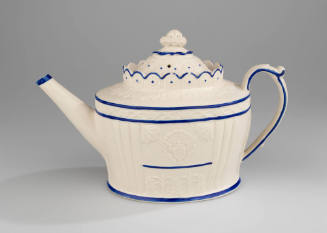
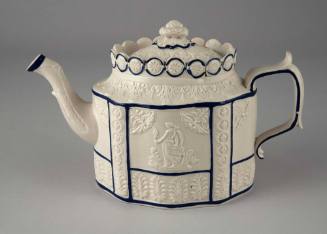
ca. 1800
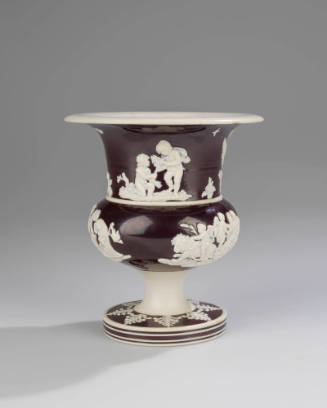
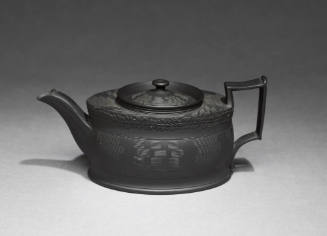
1790-1810
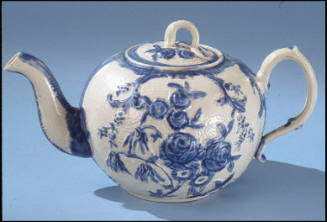
ca. 1760
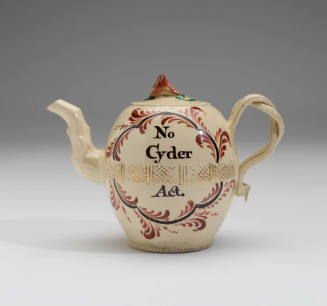
ca. 1763
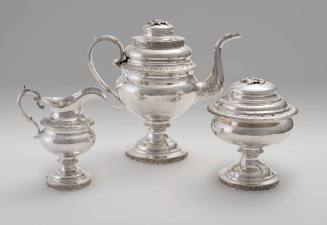
Jehu Williams (1788-1859) and John Victor (1793-1845) (Williams & Victor)
ca. 1835