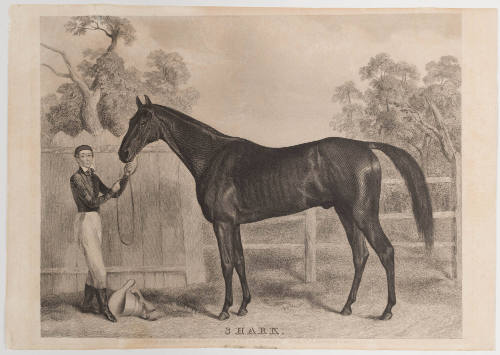
Shark
Date1840
Engraver
A. L. Dick
After work by
Edward Troye
MediumSteel engraving on wove paper
DimensionsOverall: 12 1/2 × 17 5/8 in (31.75 × 44.77cm)
Platemark: 12 1/8 × 15 5/8 in (30.8 × 39.69cm)
Platemark: 12 1/8 × 15 5/8 in (30.8 × 39.69cm)
Credit LineMuseum Purchase, The Friends of Colonial Williamsburg Collections Fund
Object number2024-251
DescriptionA black and white print of a horse named, "Shark" with a figure dressed in riding clothes standing holding the reigns. Lower margin reads, " Bred by Charles Henry Hall. Esq.r of Harlaem, N.Y. now the property of Col. Wm. R. Johnson of Virginia."Label TextThis print includes a portrait of "Shark," a racehorse owned by Col. William Ransom Johnson of Petersburg and Chesterfield County, Virginia. Johnson, known as the "Napoleon of the Turf," had an equestrian center where he bred, owned, and trained horses. Called Oaklands, it was near the Appomattox River in Chesterfield. At Oaklands, people enslaved by Johnson worked as grooms and horse trainers. This portrait was published in the popular sporting magazine "New York Spirit of the Times," which Johnson used to promote the breeding of Shark. Edward Troye, a famed equestrian painter, originally painted this portrait of Shark after the horse won his first four-mile heat race at Long Island's Union Course on May 9, 1834. At the time of Troye's painting, Shark was owned by Commodore Robert Field Stockton of Princeton, New Jersey. Later that year, John Charles Craig of Germantown, Pennsylvania purchased Shark for $15,000, the most expensive sale for a racehorse at the time. Craig's association with Johnson led Craig to employ Johnson's services to start training Shark in 1834. Eventually, in 1839, Johnson purchased Shark for $12,000 and began to advertise Shark's services for breeding, as Shark descended from a very illustrious horse-racing family. Johnson was also a patron of Edward Troye, who spent time at Oaklands painting Johnson's horses.ProvenanceBefore 2024, Old Colony Shop (Alexandria, VA); Before 2024, Thistlewaite Americana (Middleburg, VA); 2024-present purchased by The Colonial Williamsburg Foundation (Williamsburg, VA).
1860-1880
William Charles
ca. 1810