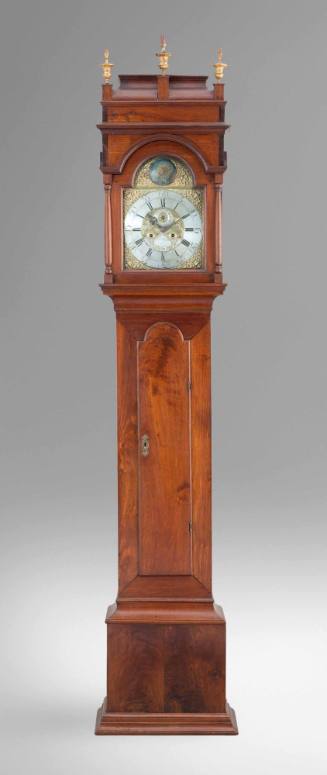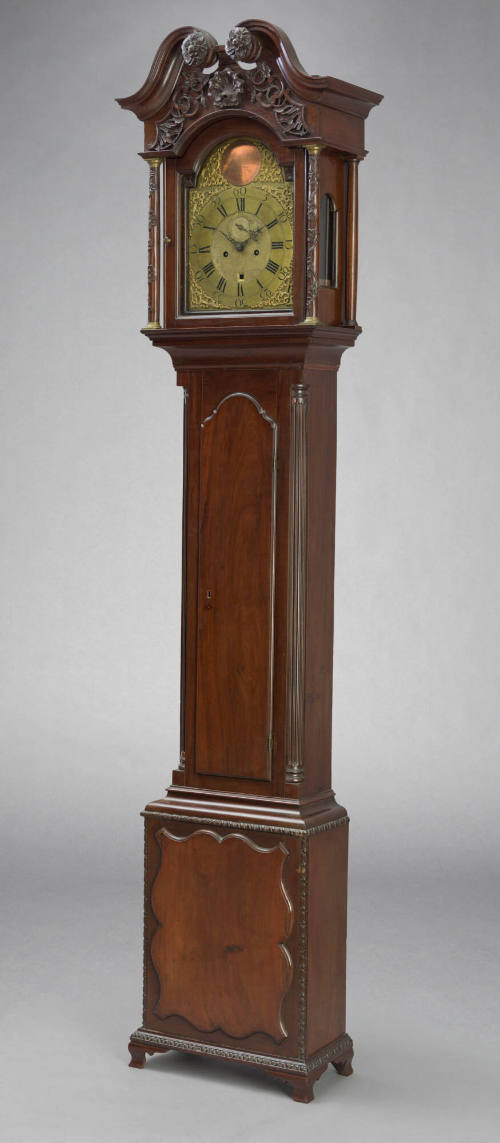
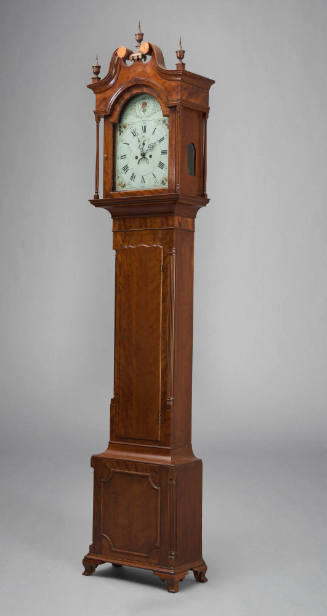
Tall case clock
Date1762
Maker
William Faris
Signed by
Seth Flower
MediumMahogany, white pine, yellow pine, glass; brass, iron, steel, resin, and copper
DimensionsOH: 100” (double check); OW: 22 ¾”; OD: 12 ¾”
Credit LineMuseum Purchase, The Friends of the Colonial Williamsburg Collections Fund and the TIF Foundation in memory of Michelle A. Iverson
Object number2024-174,A-H
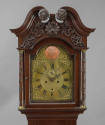
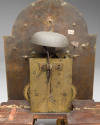
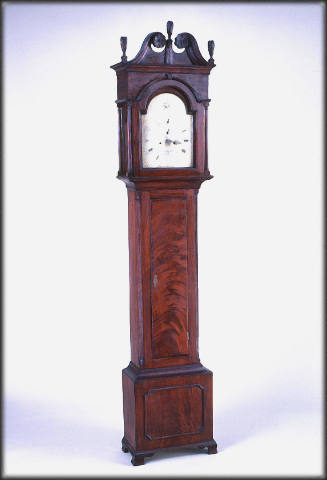
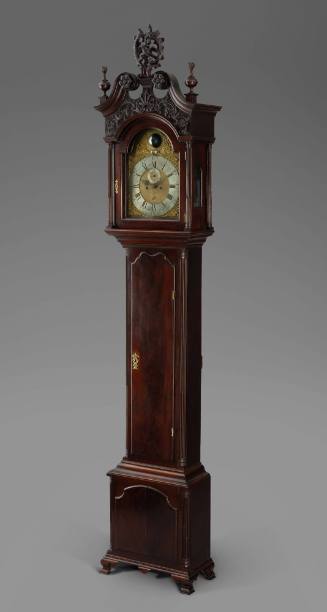
DescriptionTall Case clock; mahogany case with broken scroll pediment with carved rosettes over tympanum with Rococo carved center shall, 4-petal flowers, C scrolls, and leafage over an arched molding over arched side lights and arched glazed door flanked by columns at front and back; front columns carved with trailing vine and flowers; brass capitals and bases on columns; inner face frame behind door carved at top corners with 4-petal flowers; stepped and coved molding over trunk with fluted quarter columns and arched door over an ogee waist molding with a gadrooned edge; based has applied serpentine shaped panel flanked by a floral rope molding on front corners, over an egg and dart base molding over ogee bracket feet (replaced). Dial:
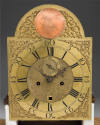
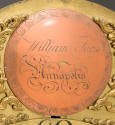
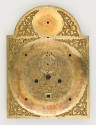
One piece arched brass dial. Round copper name boss in center of arch, engraved “William Faris/ Annapolis” flanked by cast brass spandrels; small slot below name boss with “S” and “N” at either end for strike/silent lever (lever and mechanism missing); square portion of dial has cast brass spandrels in corners around chapter ring with Arabic minute numerals in increments of 5 and Roman hour numerals; tick marks indicating all 60 minutes between the hour and minute numbers, stippled center portion of dial with seconds chapter ring with Arabic numerals in increments of 10 over hands, tick marks indicating all 60 seconds, hands flanked by two winding holes; square chamfered aperture for date below hands (date wheel missing)
Movement description:
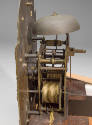
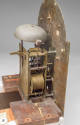
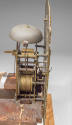
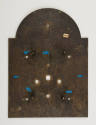
Eight-day brass time, strike, and calendar weight-driven movement measuring 7” H x 5” W. Plate thickness is 0.123” and clearance between front and back plates is 2.35”. Clock has an anchor-recoil escapement regulated by a seconds beat pendulum. A rack-and-snail strike sounds the hours on a 4.5” diameter cast brass bell. The strike hammer head is pyramidal in shape.
Four brass pillars are riveted into the back plate and pinned at the front plate. The movement is fastened to the seat board by steel hooks that hook over the bottom movement pillars and are fastened under the seat board by nuts. The brass tube time and strike barrels are grooved for the weight cords. The mainwheels are 0.139” thick. All time and strike train wheels and motion work have four-arm crossings. The round steel crutch-rod has a closed-end fork with rounded front and back edges with a rectangular cutout for the pendulum rod. The pendulum bridge base is butterfly in shape. It is fastened to the back plate with two screws and two locator pins. The bell stand is screwed to the back plate under the pendulum bridge.
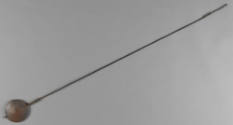
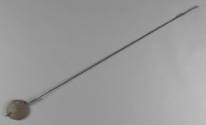
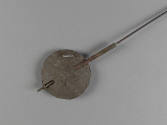
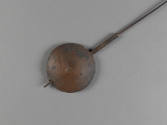
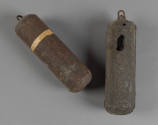
The weight pulleys are cast brass with riveted brass stirrups. The overall length of the pendulum is 43”. The bob is cast iron faced with brass. It is 4” diameter. The cast iron time weight is 2 ¾” diameter, 10”5 long with a rounded base and top. The cast iron strike weight is 2 3/4” diameter, 10 ¼” long with a rounded base and top.
Case: A
Movement: B
Pendulum: C
Weights: D&E
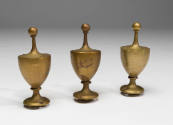
brass finials F, G, H.Label TextVery few clockmakers were working the southern colonies during the 18th century and fewer were producing clocks in their own shops rather than importing them from England for resale. Thomas Walker of Fredericksburg was one such craftsman in Virginia. William Faris, formerly of Philadelphia, was another working in Annapolis, Maryland. A small group of William Faris clocks are known from his decades in Annapolis, one of which is this example originally owned by Charles Carroll the barrister and his wife Margaret Tilghman Carroll at Mount Clare, their home in Baltimore County, Maryland. Faris documented cleaning the Carroll’s clock in his daybook in 1776. Another craftsman, Seth Flower, also formerly from Philadelphia, signed and dated the clock dial under the chapter ring. Flower was likely one of the various artisans recorded as working in Faris' Annapolis shop and appears to have been related to, perhaps the brother of, clockmaker Henry Flower of Philadelphia to whom Faris was linked by early 20th century scholars.
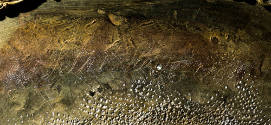
The mahogany case for this clock is a magnificent Rococo example with a strong Philadelphia influence. It may have been crafted by a cabinetmaker from Philadelphia working in Annapolis or the Baltimore area in the mid-18th century. The clock has lost its finials over time and the silvering on its chapter rings and name boss.Inscription(s)"Seth Flower/ Seth Flower 1762" scratched into dial plate under chapter ring.
"I W Robert May.. 1906 [or 1900]" scratched into rear of backplate, proper right side near edge"Mark(s)"William Faris/ Annapolis" engraved on name boss in arch of dial.ProvenanceDescended in the Tilghman, Goldsborough, and Hollyday families from Charles Carrol the barrister (1723-1789) and Margaret Tilghman Carroll (1742-1817) of "Mont Clair" (now Carroll Park), Baltimore.
Possible line of descent: Charles Carrol the barrister (1723-1789) and Margaret Tilghman Carroll (1742-1817) of "Mont Clair", Baltimore, MD; to nephew Col. Tench Tilghman and wife Anna Maria Tilghman (1755-1847); to daughter Elizabeth Tilghman Goldsborough (1786-1852) and Col. Nicholas Goldsborough (1787-1857) of Easton, MD; Family stated line of descent from this point: to daughter Clara Elizabeth Goldsborough Earle (1831-1911) of Easton, Maryland prior to 1860; to daughter Elizabeth Goldsborough Tilghman Earle Hollyday (1849-1927) of Readbourne, Queen Anne Co. and Easton, Maryland between 1831 and 1911; to son Richard Frisby Hollyday (1883-1971) of Baltimore, MD in 1927; to nephew Milton Ritchie Hollyday (1922-2009) of Philadelphia and Baltimore in 1950; to daughter Anne Hollyday Smyth in 2006; purchased c.2009 by Dick Mattingley, Royal Oak, MD
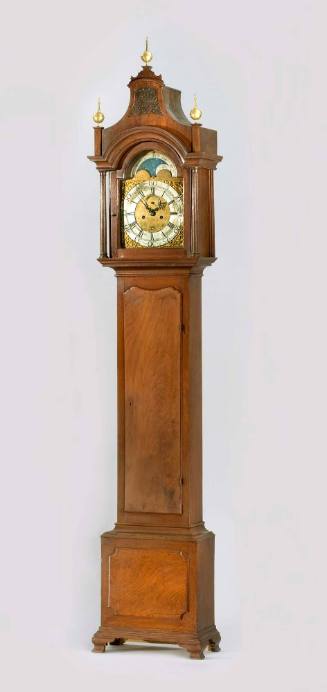
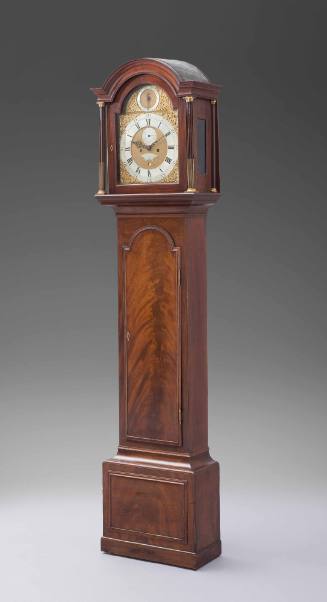
1790-1800
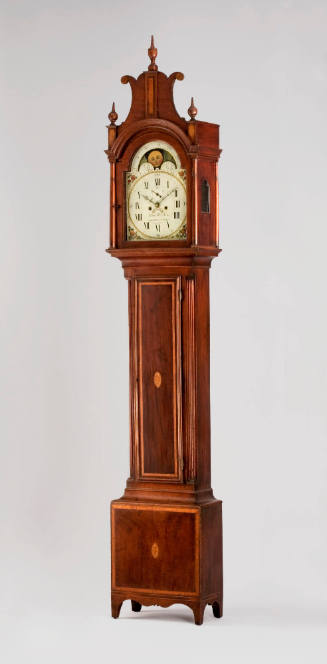
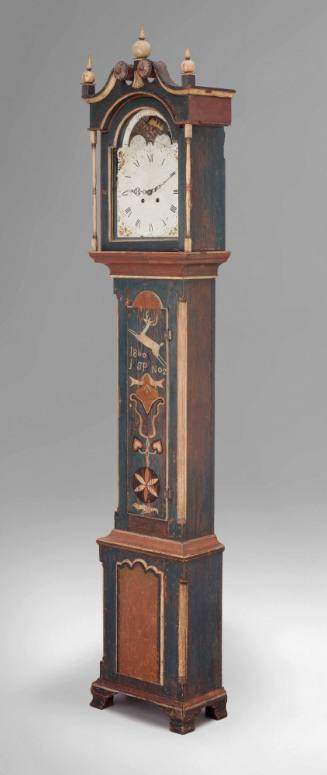
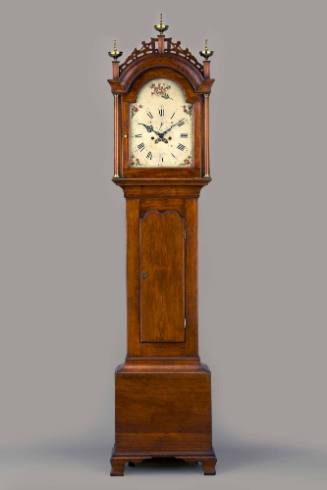
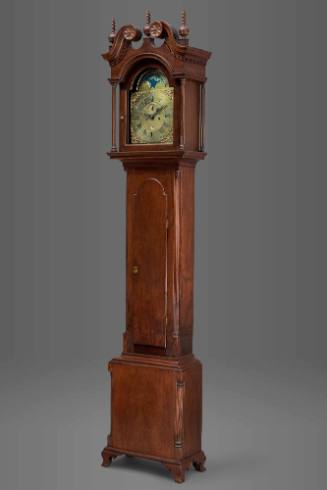
ca. 1800