
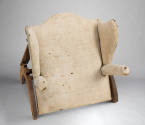
Bed Rest
Date1775-1810
MediumMahogany, yellow pine, iron, linen, Spanish moss, and curled hair (?)
DimensionsOH: 27 ¾”; OW: 25 ¼”; OD: 34 ½”
Credit LineGift of H. Furlong Baldwin
Object number2023-48
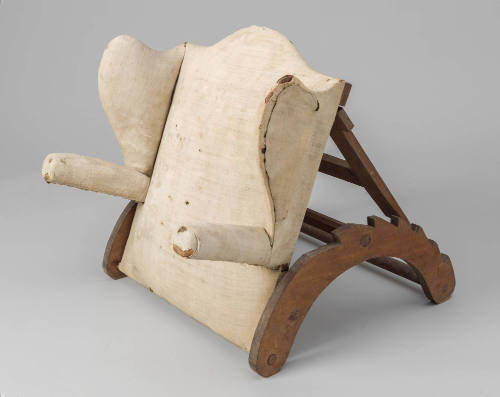
DescriptionUpholstered adjustable invalid bed rest or bed chair with ratcheting support; upholstered back with serpentine crest rail covered on front and rear with linen with shaped upholstered wings and unshaped arms projecting towards front; base composed of arched black walnut rails with stepped top edge, with six steps for adjustable tilt of back, connected to each other by stretchers at front, center, and rear of arched rails; center stretcher faceted, rear stretcher rounded, front stretcher incorporated into lower edge of upholstered chairback; back support, attached with a brass butt hinge to walnut upper back rail screwed to rear of upholstered chairback, has horizontal top to frame, two splayed vertical supports with shaped lower ends connected by a medial horizontal support.Label TextThis bed rest or bed chair would have been used on a bed for support of a sick or invalid individual during the 18th to 19th centuries. This example was discovered in the attic of Eyre Hall, built in 1759 in Northampton County, Virginia by Littleton Eyre and lived in by his descendants to present time. It survives with its original upholstery, a plain linen that would likely have been covered by a slipcover during use. Few American example of this form survive, yet they likely were more prevalent during the 18th and early 19th centuries than their survival would suggest. Elizabeth Drinker of Philadelphia lent her family’s “bed chair” to family and friends over twenty times between 1777 and 1804 and New York cabinetmaker Thomas Burling advertised in the late 1780s that he had bed chairs to rent to his customers. Even in Virginia the form was documented both with and without “cheeks” or side supports. Robert Beverley of Blandfield appears to have ordered one from London as one was included in an invoice of goods sent to him and described as a “...Sick Chair to put on a Bed for a sick Person to Lean their (sic) backs against stuffd with hair & covered with check. To raise or let Down as a Book stand. Colo Landon Carter Desir'd such an one only he would chuse it with Cheeks as in a Large Easy Chair...” (Robert Beverley to John Bland, Oct. 11, 1763, Robert Beverley Letterbook, 1761-1775, Library of Congress).ProvenanceDescent in the Eyre family of Eyre Hall, Northampton County, Virginia. Found in the attic of Eyre Hall c.2020.
1820-1860
1695-1725
ca. 1730
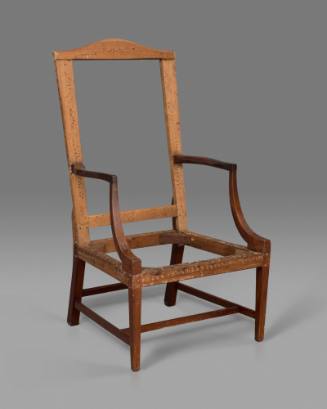
1790-1810
ca. 1790
ca. 1790
1810-1830
ca. 1765
1780-1800
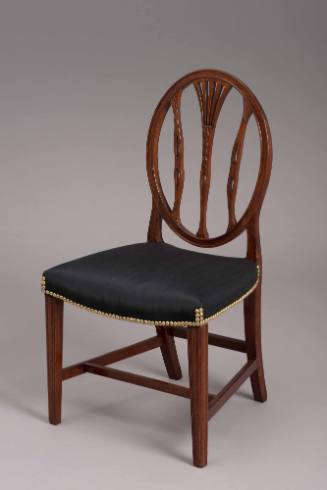
1790-1810