
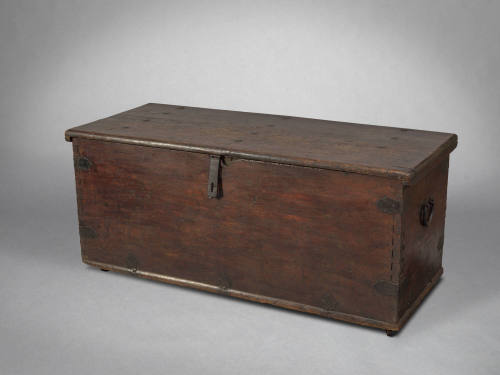
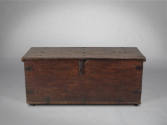
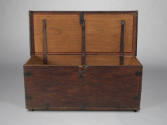
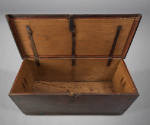
Chest
Date1700-1750
OriginAmerica or Europe
MediumAsh (by micro id: Fraxinus spp./Oleaceae), yellow pine, hickory, iron, and textile (TBD)
DimensionsOH: 25 1/2"; OW: 58 1/2"; OD: 25 1/8"
Credit LineGift of Gilbert Whitehouse
Object number2026-34
DescriptionLarge rectangular dovetailed chest with hinged lid; sides dovetailed to front and back; bottom board, with quarter-round edge extending past sides, front and back, probably nailed to underside of same; lid with battens with shaped ends nailed with clinched nails to underside of ends; lid hinged to back of chest with large iron strap hinges that are riveted on exterior of chest; hinges have rounded ends on lid and are set into a shallow groove in underside of top; all three hinges are buckled (i.e., not flat) between the end and next rivet; underside of lid has groove to receive tops of front, sides, and back when closed (groove stained or painted red); large iron carrying handles are attached to sides with iron cotter pins; backplate is foliated on both ends with D shaped handle; similar double-foliate iron straps span the corners of the sides, front and back (two each) and bottom to the side, front and back (2 each); mortised lock missing, mortise patched with yellow pine with hickory across top and a piece of fabric, leaving keyhole with evidence of a missing escutcheon; iron hasp and loop nailed to underside of lid and front of chest with clinched nails; four modern castors attached to underside of bottom; reddish color to exterior of chestLabel TextThis large utilitarian chest descended in the Fry family of Virginia and is believed to have originally belonged to Colonel Joshua Fry (1699-1754). Born in England and educated at Oxford, Fry immigrated to Virginia by 1729 and lived in James City County and Goochland (now Albemarle) County. A member of the Virginia House of Burgesses representing Albemarle County (1745-1754), professor of Natural Philosophy and Mathematics at the College of William and Mary, and Commander in Chief of the Virginia forces during the French and Indian War, Fry was also a surveyor. He is notable for having created an important map of Virgina with Peter Jefferson, first published in 1753. With its accurate depiction of rivers and terrain, this so-called Fry-Jefferson Map remained the definitive map of Virginia until the early 19th century. Whether used on military campaigns, surveying trips, or as a domestic storage form, Fry's chest endured centuries of use in a single Virginia family.ProvenanceBelieved to have originally been owned by Joshua Fry (1699-1754); descended in Fry’s family at Elim, the Fry house built by Joshua Fry’s son Henry c.1766 in Locust Dale, Madison County, Virginia; purchased at auction of house contents in 1918 by John Webb Fry (1853-1943), great-grandfather of donor; descended to donor. Probable line of descent: Joshua Fry; to Rev. Henry Fry (1738-1823); to daughter Martha Fry Lightfoot (1767-1828); to son Reuben Edward Lightfoot (1800-1882); to son John Lightfoot (1836-1880); to son John Turner Lightfoot (1861-1914) and wife Lucie Elizabeth Garrett Lightfoot (1866-1947); to son Edward Valentine Lightfoot (1897-1918); sold 1918 at auction of Elim’s contents to John Webb Fry (1843-1853), great-grandson of Rev. Henry Fry (1738-1823), and great-grandfather of the donor.
Or Joshua Fry; to Rev. Henry Fry (1738-1823); to son Joshua Fry (1769-1838); to son Henry Belville Fry (1794-1836); to daughter Mary Emily Fry Garnett (1833-1921); to daughter Lucie Elizabeth Garnett Lightfoot (1866-1947) and John Turner Lightfoot (1861-1914); to son Edward Valentine Lightfoot (1897-1918); 1918 sold at auction of Elim contents to John Webb Fry.
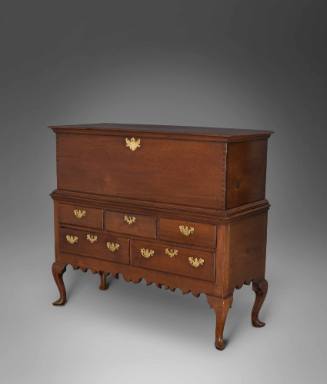
1750-1765
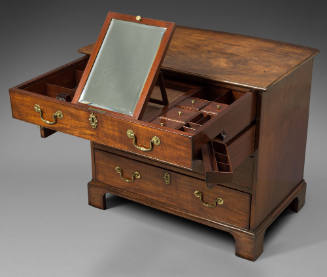
ca. 1770
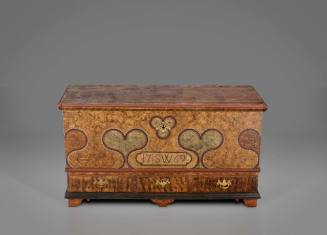
1769
1700-1730
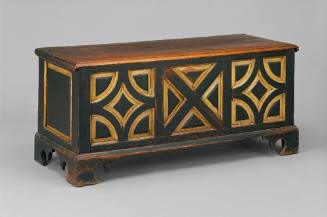
1795-1805
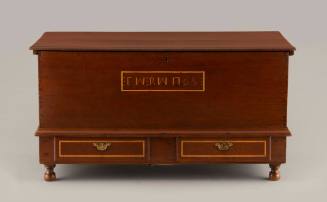
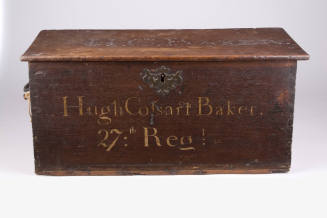
ca. 1775
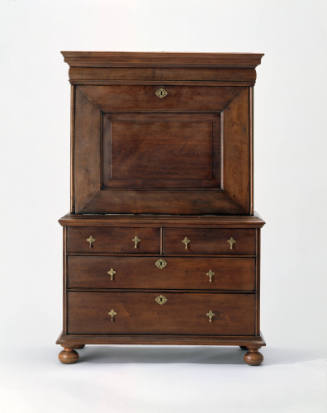
ca. 1740