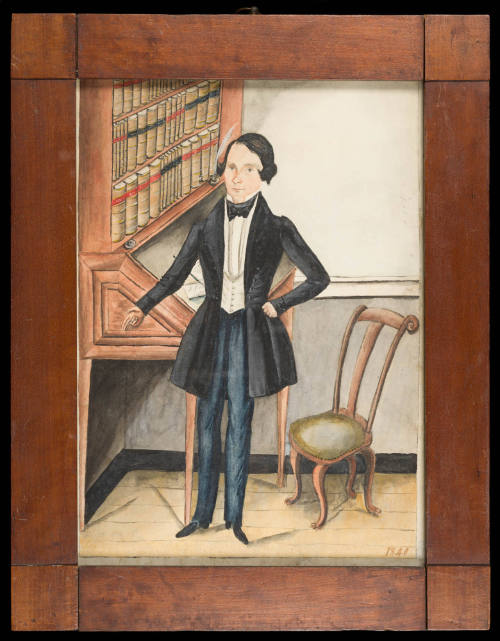
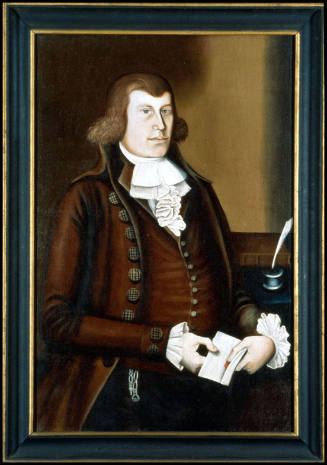
Portrait of Robert Parkinson
Date1840
Maker
Jacob Maentel
1778 - 1863
MediumWatercolor on paper
DimensionsOverall: 15 × 11in. (38.1 × 27.9cm)
Credit LineGift of an Anonymous Donor
Object number2020.300.3,A&B
DescriptionFull length portrait of a man in a black frock coat and matching trousers. He is depicted in a frontal pose, in the corner of a room with chair rail, painting wainscoting, and wooden floor. He stands with one arm on his hip the other leaning on a stand up school masters-type writing desk with tapered legs and open shelved secretary top lined with rows of leather bound books. The desk section with a partially written letter and ink well with quill pen. To the right is a Chippendale side chair with eared crest, solid splat, over upolstered seat with brass tcks, and stylized cabriole legs ending in scrolled or claw-and-ball feet.Label TextRobert Parkinson was born in Westmorland County, England in 1816. He immigrated to the United States as a young man and married Frances Jane Russell in 1842. Together they lived in Mt. Carmel, Illinois and had ten children. The artist, Jacob Maentel, created this piece a few years after moving west himself. A German-American artist who had previously worked in Maryland and Pennsylvania, Maentel and his family settled in New Harmony, Indiana in 1836. Surviving works suggest that Maentel was traveling regionally, perhaps along the Wabash River, for commissions. This is one of only a small handful of portraits done by the artist that include an interior scene.
Mark(s)Affixed to the backing is an early handwritten family label, ink on paper, which states the following: "Robert Parkinson, Born in Westmoreland County, England 1816 - October 9th Died Mt. Carmel Illinois April 8th 1878. Married Frances Jane Russell Nov 22 - 1842, born Aug 9 1824 Died March 22nd 1877." ProvenanceBefore 2001, private collection (Evansville, IN); 2001; acquired by David A. Schorsch American Antiques, Inc. (Woodbury, CT); 2001, purchased by Colonial Williamsburg's vendor; 2020, donated to The Colonial Williamsburg Foundation.
ca. 1785
ca. 1740