Image Not Available
for Filing Press
Filing Press
Date1805-1810
Maker
John Hockaday
MediumBlack walnut and yellow pine, and brass
Dimensions: OH: 41 ¼”; OW: 26”; OD: 15 ½”
Credit LineGift of the Thomas Jefferson Foundation at Monticello
Object number2026-139
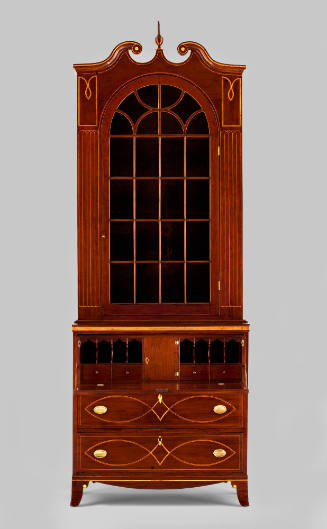
DescriptionAppearance: Tall, narrow case with single flat paneled door, mitered corners, hinged on proper left with inset brass keyhole on proper right, with applied bead outlining panel; rectangular top with molded overhanging edge on front and sides; ogee base molding with shaped bracket feet on pads below; interior divided into three vertical sections with center section slightly wider than side sections; side sections formed by six vertical pigeon holes (no valances); center section has single drawers at top and bottom, each with scratch-bead around perimeter of drawer front and an inset keyhole (missing), with two tall vertical moveable dividers (with eight slot positions for dividers) between the two drawers.Construction: Sides through dovetailed to top and presumably to bottom. Proper right side has extra stile butt joined to front edge of side, the thickness of the door, the top of which is exposed through the top board next to the dovetails. Mitered top molding is nailed to the edge of the top on the front and sides.
Interior partitions are dadoed into the sides, top and bottom from the rear, and to the vertical partitions with exposed dados on their front edges. Interior partitions are yellow pine with c.3” walnut fronts; front edges are square. Bottom board has very slight rabbet along the front edge even with front of dividers to act as a door stop
Walnut boards, mitered at corners, with integral ogee molded edge serving as base molding are nailed to the underside of the bottom board on the front and sides and (unevenly/not symmetrically) at the ends of the rear. Rear boards were turned and have the molded edge towards the front (ie not visible) rather than to the rear. Bracket feet are attached to the underside of the walnut boards with a vertical, roughly quarter round glue block flanked by horizontal rectangular with chamfered corner glue blocks (one shaped); pad under foot and block. Rear feet are angled brackets dovetailed to side rear bracket feet, no horizontal flanker glue block against angled bracket on PL side; PR side has non-original flanker glue block.
Drawers have standard dovetailed construction. Drawer sides with single bead slightly lower in height than drawer front; drawer back squared edge and lower than drawer sides. Drawer bottom in dado in sides and front, very slightly chamfered around sides and front with wedge shaped segmented glue blocks around sides and front; bottom nailed with spring nails to underside of back; bottom and sides extend slightly past back perhaps to served as drawer stops. Drawer fronts have scratch bead around perimeter, with scratches crossing at corners. Locks and key holes that originally had inset brass escutcheons (now missing)
Door – mitered mortise and through tenon construction with flat panel in dado in stile and rails. Bead molding nailed to front around panel. (both side bead moldings replaced); scratch bead around perimeter of door.
Backboards vertical: thin center batten lapped to two wider side boards; nailed with rosehead nails; backboard nailed in rabbet in sides and top and to back edge of bottomLabel TextThis storage form descended in St. George Tucker's family and house in Williamsburg, Virginia. Rather like a modern filing cabinet, papers and ledgers books could be stored within the case and could be moved with relative ease using the brass carrying handles within a home. Williamsburg cabinetmaker John Hockaday made a number of pieces of furniture for St. George Tucker in the early 19th century including a “Paper press- colored black walnut £5” on May 24, 1805 and a “paper press with pigeon holes- colored-black walnut £5” on December 1, 1810. This is likely one of those two paper presses. Thomas Jefferson used a similar furniture form for filing his papers, although he used shelves and paper boxes or cartons for his alphabetically organized papers rather than ledger books and pigeon holes. Colonial Williamsburg owns two other pieces of furniture that John Hockaday made for Tucker, a chest of drawers #2008-21 and a hanging bookcase #2025-46.ProvenanceFound in the St., George Tucker House in Williamsburg in the 20th century. Thought to be one of the Jefferson paper presses that had been brought to Williamsburg in the 19th century when Jefferson's papers were organized. Now believed to be the paper press John Hockaday made for Tucker in 1805.
ca. 1800

1760-1780
1700-1730
ca. 1800
1760-1775
1765-1775

ca. 1740