
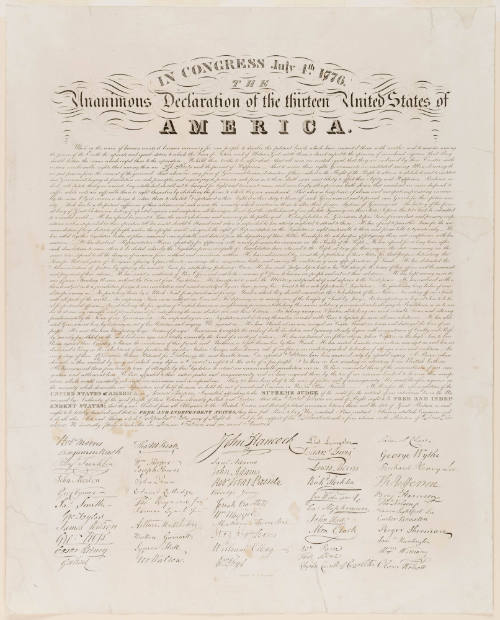
Declaration of Independence
Date[between 1820 and 1824]
MediumInk on paper.
DimensionsOther: (Unframed) : 5 9/16 × 20 1/16 in (65 × 51cm); Framed: 34 1/4 × 28 3/4 in (87 × 73cm)
Credit LineSpecial Collections, John D. Rockefeller, Jr. Library, Colonial Williamsburg Foundation
Object numberSCMS2007.7
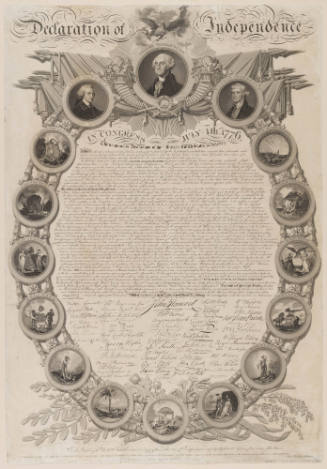
DescriptionLittle is known about the life of Eleazer Huntington. He was a penmanship master and engraver in Hartford, Connecticut, who wrote several books on penmanship including The American Penman (1824). His calligraphic engraving of the Declaration of Independence was issued after those of Benjamin Owen Tyler (SCMS2008.2), and John Binns (SCMS2008.3) from whom he borrowed parts of his design. The signatures in the Binns broadside were copied by John Warr Jr., engraver of Philadelphia, for John Sanderson’s Biography of the Signers of the Declaration of Independence (SCRB00381). Huntington copied Warr in the production of his signatures for the Declaration. Huntington was a subscriber to Tyler’s printing, using it as the basis for the overall design of his work. Huntington’s design, like that of Tyler’s, highlights his background in penmanship and calligraphy. The title is ornate and decorated with calligraphic flourishes. Compared to Tyler, Huntington was restrained in using his skills to draw attention to passages in the text. He highlighted only one phrase not emphasized in the original engrossed copy of the Declaration, the words “SUPREME JUDGE” in the final paragraph.
It is in the signature area of the Declaration that Huntington’s design most significantly differs from the original. In the original Declaration, the signatures are arranged in six columns with as few as three and as many as thirteen names per column. Huntington arranged them in five columns. The first four columns contain eleven signatures and the fifth contains twelve. This gives a much more uniform appearance to the end of the document. In addition, Huntington changed the order of the signatures. In two cases, this was done to group all the signers from a given state together. This required placing all the signatures from the Massachusetts signers under that of John Hancock, who signed first as the President of the Continental Congress. Huntington also moved the signature of Matthew Thornton to locate it with that of the other two signers from New Hampshire. Thornton was elected to Congress in September 1776 and was therefore not present at the August 2 signing. When he finally signed on November 4, he found that Samuel Adams had left him no room under Josiah Bartlett and William Whipple, the other two signers from New Hampshire. Huntington’s arrangement of signatures resolved these discrepancies and created a pleasing composition.
While he certainly took advantage of the previous marketing of Binns and Tyler to launch his own production, Huntington does not appear to have widely advertised his engraving. He seems to have intended his production to only appeal to his fellow Connecticut citizens.
ProvenanceBefore 2007 William Reese Company; 2007-present, purchased by the John D. Rockefeller, Jr. Library, Colonial Williamsburg Foundation


ca. 1825
April 1, 1773


1783
