
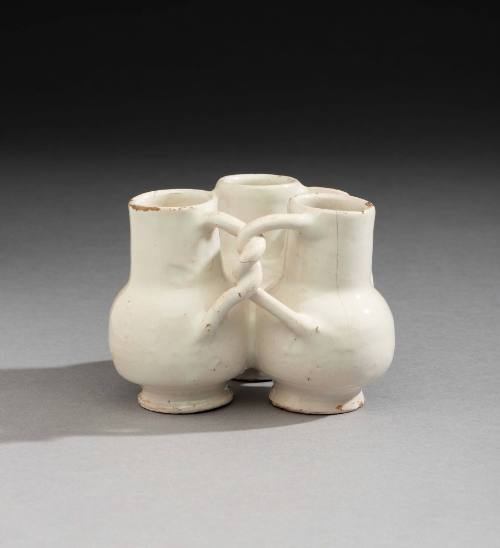
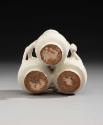
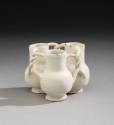
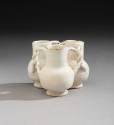
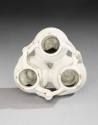
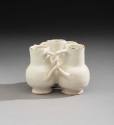
Fuddling cup
Dateca. 1660
OriginEngland, London
MediumTin-glazed earthenware (delft / delftware)
DimensionsH: 3 5/8" (9.2 cm)
Credit LineMuseum Purchase
Object number1952-502
DescriptionThree connected baluster-shaped containers with long cylindrical necks and spreading feet, each with a pair of loop handles entwined with handles of the adjacent bottles. Holes at points of contact permit liquid to flow between vessels.Label TextAlthough the term fuddle, meaning "to intoxicate," goes back at least to the sixteenth century, there is no evidence to show that the term fuddling cup was used for vessels of this form when they were made and used in the seventeenth century. It is, indeed, probable that these vessels were used to surreptitiously get someone drunk, however. A person who believed he was drinking the liquid from only one of the three pots would have been drinking from all three. The form's use, at least as a drinking vessel, is suggested by a privately owned example inscribed "DRYNCK ALL BOYSE," with one word on each container, making it possible to read the inscription three different ways. Lipski records nine dated examples, all earlier than this, some with painted decorations. In addition to this three-sectioned vessel, other English fuddling cups survive with four or more sections. The London attribution for this example is based on the color of the glaze.
Fuddling cups were also made in Germany, where the form was more elongated with less of a shoulder.Inscription(s)NoMark(s)NoProvenanceD. M. & P. Manheim, London


ca. 1680

1750-1770

ca. 1810
1650-1675


ca. 1760
1655-1656
