Harpers Ferry
DateProbably 1857-1865
OriginAmerica
MediumOil on canvas
DimensionsFramed: 27 7/8 x 36. Unframed: 26 5/8" x 34 1/2" (67.6 cm. x 87.6 cm.)
Credit LineMuseum Purchase
Object number1958.102.7
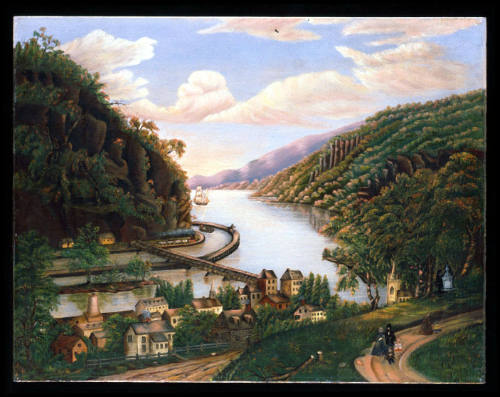
DescriptionView of Harpers Ferry from the hill above the town looking down river. The lower right corner is the hill with a path. A man with his wife on his arm walks down the path, holding the hand of his little girl, and his son rolls a hoop in front. Also on the hill is a man in a tall black hat leaning against a tombstone in a mourning attitude. The church steeple is visible. To the left in the foreground, one looks downhill and sees houses of the town leading down toward the river bank. The Potomac River enters from lower left corner and one can see a covered bridge leading from town to the far bank. There is a canal going around the bend of the land on the far side and a man is trying to lead a balky canal boat mule. There is also a small train rounding the bend alongside the canal. The Shenandoah River enters from the right side of the painting, behind the hill on which the church stands. These two rivers merge to form the Potomac, and these combined rivers flow down through the center of the canvas into the distance toward purple mountains. A large sailing vessel is visible sailing downriver. The sunlight appears to be coming from behind the mountains to the left and casts a pinkish glow on the vegetation.Label TextAlthough based on an undated black-and-white lithograph issued by Currier & Ives, the painting includes a number of compositional details that appear to be original. The most significant of these are the felled tree in the foreground, the sailing vessel near the bend in the river, and the monument and black-garbed mourning figure at the far right.The mourning vignette is especially suited to the time of day. Using bright pink pigments, the artist tinted not only the horizon, clouds, and distant mountains, but also the edges of much of the landscape foliage that realistically might have caught the sun's dying rays.
Harper's Ferry suffered considerable damage during the Civil War, including the destruction of the covered bridge crossing the two railroad lines.
Mark(s)None visibleProvenanceJ. Stuart Halladay and Herrell George Thomas, Sheffield, Mass. Halladay died in 1951, leaving his interest in their jointly-owned collection to his partner, Thomas. Thomas died in 1957, leaving his estate to his sister, Mrs. Albert N. Petterson, who was AARFAC's vendor.
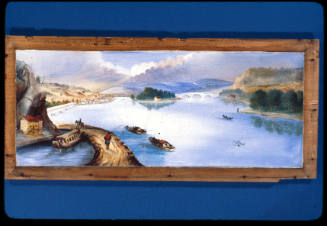


Probably 1852-1875
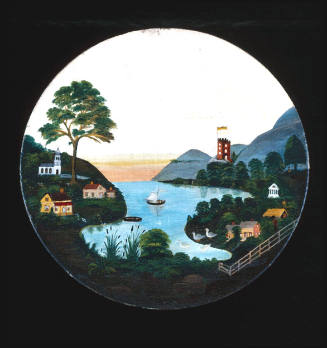
ca. 1850
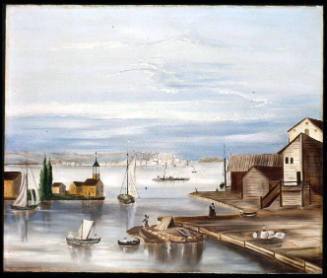
ca. 1850