
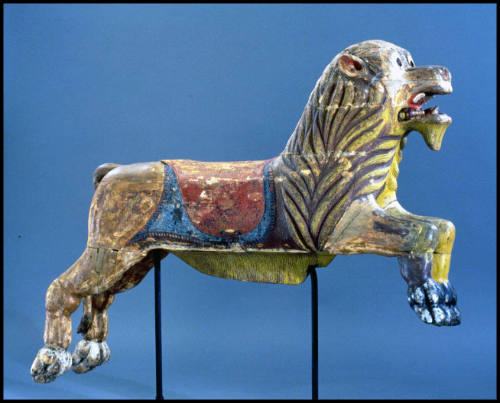
Carousel Figure: Lion
Dateca. 1880
Possibly by
Maskell Ewing III (?-?)
OriginAmerica
MediumPainted basswood with iron bit, claws, and stirrup attachment
DimensionsOverall: 38 x 54 x 13 1/2in. (96.5 x 137.2 x 34.3cm)
Credit LineMuseum Purchase
Object number1957.703.2
DescriptionA figure of a leaping lion, fashioned in the round from multiple pieces of basswood glued and nailed together forming a hollow core, the exterior carved and painted. The tail curves down alongside the proper left rear leg. The two front legs are shown in the same position; the two back legs are similarly positioned like one another. The paint scheme remains as it was at the time of acquisition: black paws, yellow body, traces of red in the nostrils and on the tongue, and a red saddle over a green saddle blanket. (See conservator Steve Ray's analyses for a record of earlier layers of paint). The eye sockets are concave and appear to have once held eyeballs but remain empty as they were upon acquisition. The mane is carved in low relief in a stylized manner. The saddle and blanket are suggested by similarly low relief carving. An iron bit is held in the mouth, which is open, exposing teeth and tongue. One iron staple (stirrup attachment) remains. A projecting ventral ridge is carved in parallel lines, seemingly representing body hair hanging down.Artist unidentified.Label TextThe figure's unmaturalistic pose, naïve anatomical rendering, and stylized interpretation of texture identify it as the work of a novice carver and suggest a relatively early date of fabrication. Naivete and simplicity need not diminish a carving's power and effectiveness, of course, and several features make the lion a successful embodiment of fearsomeness. A cascading mane amplifies the bulk of the head and neck, enhancing the creature's ferocious countenance and, by contrast with its sleek trunk, emphasizing the explosive force of its spring. For small children, touching and riding this lord of the jungle would have constituted a thrilling flirtation with terror.
The lion was found at Brandriff Beach, New Jersey, but is believed to have used previously on Maryland's Eastern Shore.
Inscription(s)Crude incisions on the underside of the body appear to read "VILLO," the meaning of which is unknown.ProvenanceSaid (by Halpert; see below) to have been owned originally on the Eastern Shore of Maryland; found at Brandriff Beach, Salem County, New Jersey, by Edith Gregor Halpert, Downtown Gallery, New York, NY.






ca. 1760
ca. 1765