
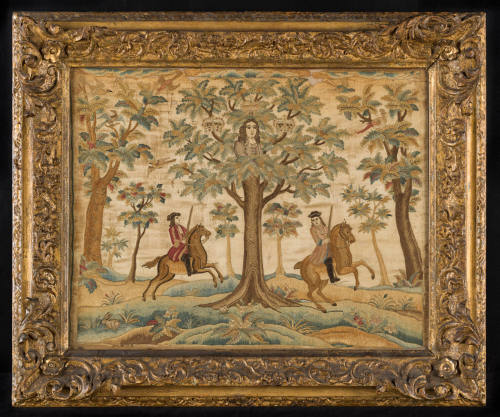
Needlework Picture by Unknown Maker
Date1720-1730
OriginEngland
MediumSilk embroidery on silk satin ground (fiber identification by eye)
Dimensions(framed) OH: 17 1/2"; OW: 21"; (sight) OH 12 5/8"; OW: 15 15/16"
Credit LineMuseum Purchase
Object number1936-647
DescriptionThis is a framed needlework picture showing Charles II hiding with two horsemen in pursuit, executed primarily in satin stitch with very fine twisted silks of rose, blue, tan, brown, gold, yellow, and greens on a cream-white satin ground. There are beautifully embroidered detail in facial features, horses, small animals, insects, trees and costumes indicating a skilled hand. The picture is in a gilt gesso frame.Label TextThis embroidered picture shows Charles II hiding with two horsemen in pursuit. It may have been created by a schoolgirl whose family supported restoring the Stuarts to the British throne. The future Charles II is said to have hidden in a large oak tree to escape capture by Cromwell's forces in 1651. The Boscobel oak became the symbol in the eighteenth century for the Jacobites.Stitched in Time:
Needleworkers didn't shy away from political themes, and patriotic imagery abounded on both sides of the Atlantic. In England, members of the royal family were frequently depicted. Surviving likenesses, usually stitched portraits, date back to the mid-17th century and show Stuart kings such as Charles I and Charles II.
The imagery in this picture, while depicting English royalty, may be slightly subversive. Though made between 1720 and 1730, this scene is from the English Civil War (1642-1651), when a pursued Charles II hid in an oak tree to escape capture by Parlimentary forces. By the 1720s, the Hanoverian kings had succeeded to the British throne, but many still supported the deposed Stuarts. These supporters, known as Jacobites, adopted the infamous oak as a symbol of their cause.ProvenancePrior to 1936, Mallett & Son (London, England); 1936-present, purchased by The Colonial Williamsburg Foundation (Williamsburg, VA)
1660-1680


ca. 1680


ca. 1780

Late 17th-early 18th century

1650-1675