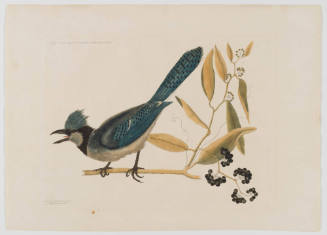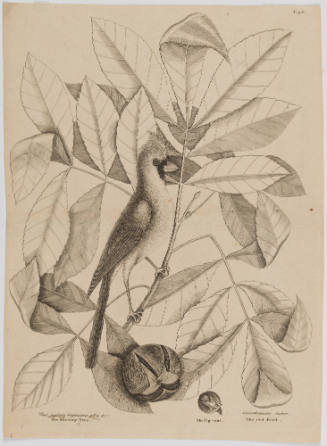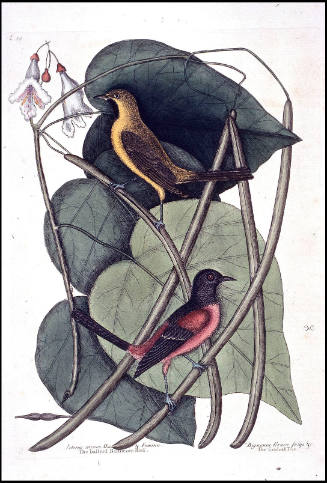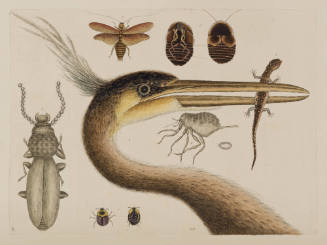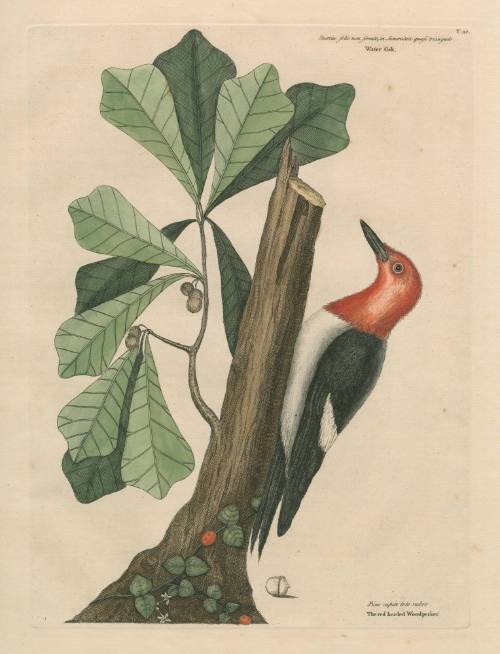
The red headed Woodpecker and Water Oak
Date1731-1743
Engraver
Mark Catesby
1683 - 1749
OriginEngland, London
MediumEtching on laid paper with hand coloring
DimensionsOverall: 20 1/4 × 13 3/4in. (51.4 × 34.9cm)
Other (Plate): 14 × 10 1/2in. (35.6 × 26.7cm)
Other (Plate): 14 × 10 1/2in. (35.6 × 26.7cm)
Credit LineMuseum Purchase
Object number1964-112
DescriptionUpper right margin: "T. 20./ Quercus folio non serrato, in Summitate quasi triangulo/ Water Oak./ Picus capite toto rubro/ The red headed Woodpecker"Label TextDuring the 18th century, the American continent provided a vast, boundless field of study for those interested in natural history. One of the most important early works on the subject was The Natural History of Carolina, Florida, and the Bahama Islands by Mark Catesby. He first came to Virginia in 1712 and spent seven years with his sister, living in Williamsburg. His second trip to the colonies in 1722 was for the purpose of gathering information and specimens for a natural history of the region. The completed two-volume work contained 220 etchings of plants, birds, fish, insects, snakes, and other forms of animal life.Of the woodpecker, Catesby wrote “In Virginia very few of these Birds are to be seen in winter: in Carolina there are more, but not so numerous as in summer; wherefore I conceive they retire Southward, to avoid the cold. This is the only one of the Wood-peckers that may be termed domestick, frequenting Villages and Plantations, and takes a peculiar delight in ratling with its Bill on the boarded houses.” Catesby was the first naturalist to observe the migration of birds. His discovery was published in the proceedings of the Royal Society of London.
Mark(s)T. 20. No visible watermark, but possibly buried in black ink of coloring.ProvenanceBefore 1964, the Old Print Shop (New York, NY); 1964-present, purchased by the Colonial Williamsburg Foundation (Williamsburg, VA).