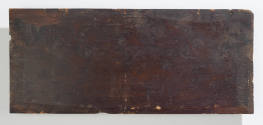
Stent Panel
DateEarly-mid 17th century
OriginEngland or Netherlands
MediumElm and paint
DimensionsOH: 10 ¼”; OW: 24 1/8”; OD: 1 5/8” unframed
Credit LineMuseum Purchase, The Friends of Colonial Williamsburg Collections Fund in memory of James M. "Jay" Gaynor
Object number2026-109
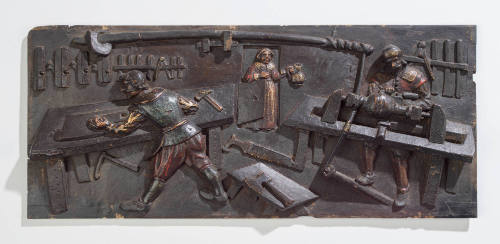
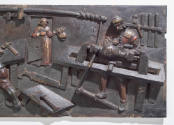
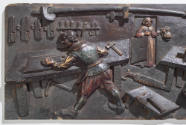
DescriptionRectangular, high-relief carved panel depicting two craftsman, a joiner and a turner, working in a shop. Joiner on the left, seen from rear, planning a board against a bench stop with a hammer next to him on his bench, bench legs pierced with holes; turner at a slab-type pole lathe on the right turning a bulbous element, the pole attached to the ceiling above with rope wrapped around the pole, descending to the lathe and then to the foot treadle; woman entering a half door between them holding a pitcher; rectangular short stool between them in the foreground with a hatchet on it and a saw on the floor nearby; hold fast on floor under joiner’s bench. Planes, chisels, and pair of compasses on wall behind joiner’s bench. Turning chisels and pair of compasses on wall behind turner. Polychrome visible on some elements. Joiner’s pants are red, tunic is blue/green. Turner’s tunic is red. Woman's dress is red. Turner's tunic and stockings are red. Panel arrived in later gilt and molded frame.Label TextThis panel was carved by a 17th century woodworker who likely worked in a shop similar to the one illustrated. He would have owned and used tools and workbenches of the type depicted, suggesting that his rendering is the most accurate view we have today of a 17th century northern European joiner's or turner's shop. The original purpose of this carved panel is unknown, but perhaps it served as a part of a piece of furniture or architecture. While the surface is currently dark, early finish analysis suggests that it was originally quite colorful with polychrome figures on a light colored background. Further analysis will be done to determine the original color scheme of the panel.ProvenanceDr. John Frederick Stent (1902-1980), Shere, Surrey, England; mid-1970s gifted to stepson Duncan McNab (son of Peggy Twitchen Stent), Australia (d.2025); to son Justin McNab, Peterborough, Australia; purchased by Colonial Williamsburg 2026

ca.1750-1850, with 20th c. elements

ca. 1825